


CPA Marketing in 2026 is reshaping the entire performance marketing landscape. According to recent industry data, the global affiliate marketing industry reached $18.5 billion in 2025 and is projected to approach $22 billion by 2027. What’s fueling this rapid expansion? A performance-driven model where advertisers pay only for measurable results—Cost-Per-Action (CPA) marketing.
As digital ecosystems become more data-driven and ROI-focused, CPA is emerging as one of the most powerful revenue strategies for entrepreneurs and brands alike.
If you’re an entrepreneur looking to amplify your digital presence and generate consistent online income, understanding CPA marketing is no longer optional. In fact, 65% of global brands report that CPA is the most efficient digital marketing model available today—and for good reason.
Unlike traditional advertising models that charge for impressions or clicks that may never convert, CPA ensures you invest only when real, trackable actions occur. This performance-based approach minimizes risk, maximizes return, and creates scalable growth opportunities in today’s competitive digital economy.
Let me walk you through everything you need to know to leverage this powerful marketing strategy effectively.
What Exactly Is CPA Marketing?
CPA Marketing is an online advertising payment model where payment depends solely on qualifying actions. Think of it as performance-based marketing at its finest—you earn money when users complete specific actions, not just when they see an ad or click a link.
As a subset of affiliate marketing, CPA has become indispensable in today’s digital ecosystem. The beauty of this model lies in its flexibility and precision. From the affiliate’s perspective, you can earn commissions when users:
- Fill out a form
- Submit their contact details
- Provide an email address
- Subscribe for a free product download
- Complete a purchase
- Install an application
The most compelling advantage? You can generate income even when you’re not actively working. The user performs the action, and you get paid. However, the catch is strategic—you need to promote the right products through the right channels to the right audience.
The Four Key Players
Understanding the CPA ecosystem requires knowing the four main parties involved:
The Merchant (Vendor): The business offering products or services and willing to pay for specific customer actions.
The Network: The intermediary platform that facilitates transactions, tracks conversions, and manages payments between merchants and affiliates. Networks like MaxBounty and PeerFly have become industry standards.
The Publisher (Affiliate): You—the marketer who promotes offers and drives traffic to complete desired actions.
The Customer: The end user who takes the qualifying action that generates your commission.
Understanding Different CPA Payment Models
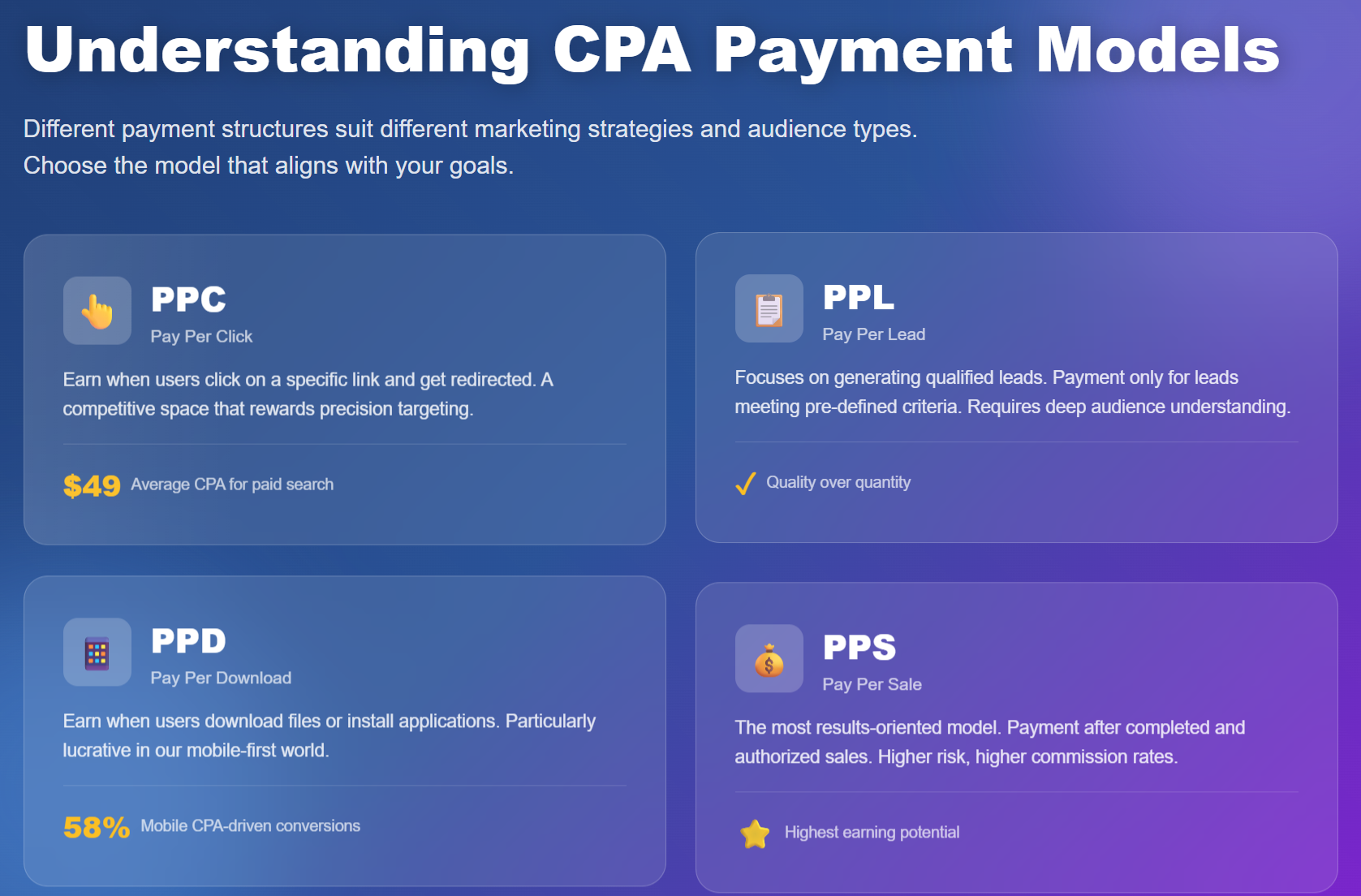
Not all CPA offers are created equal. Different payment structures suit different marketing strategies and audience types. Let me break down the main models you’ll encounter:
Pay Per Click (PPC)
With PPC or Cost Per Click, you earn when users click on a specific link and get redirected to a destination. While clicks don’t guarantee conversions, the average cost per action (CPA) is $49 for paid search, making it a competitive space that rewards precision targeting.
Pay Per Lead (PPL)
PPL focuses on generating qualified leads. You only receive payment for leads that meet pre-defined criteria—partial or incomplete information doesn’t count. This model requires understanding your audience deeply to attract genuinely interested prospects.
Pay Per Download (PPD)
Also known as Cost Per Install, this model pays when users download a required file or install an application. The mobile-first world has made this particularly lucrative—mobile accounts for over 58% of all CPA-driven conversions.
Pay Per Sale (PPS)
Known as Cost Per Sale, this is the most results-oriented model. Payment occurs only after a sale is completed and authorized. While this carries higher risk for affiliates, it typically offers higher commission rates to compensate.
Mastering Traffic Generation for CPA Success
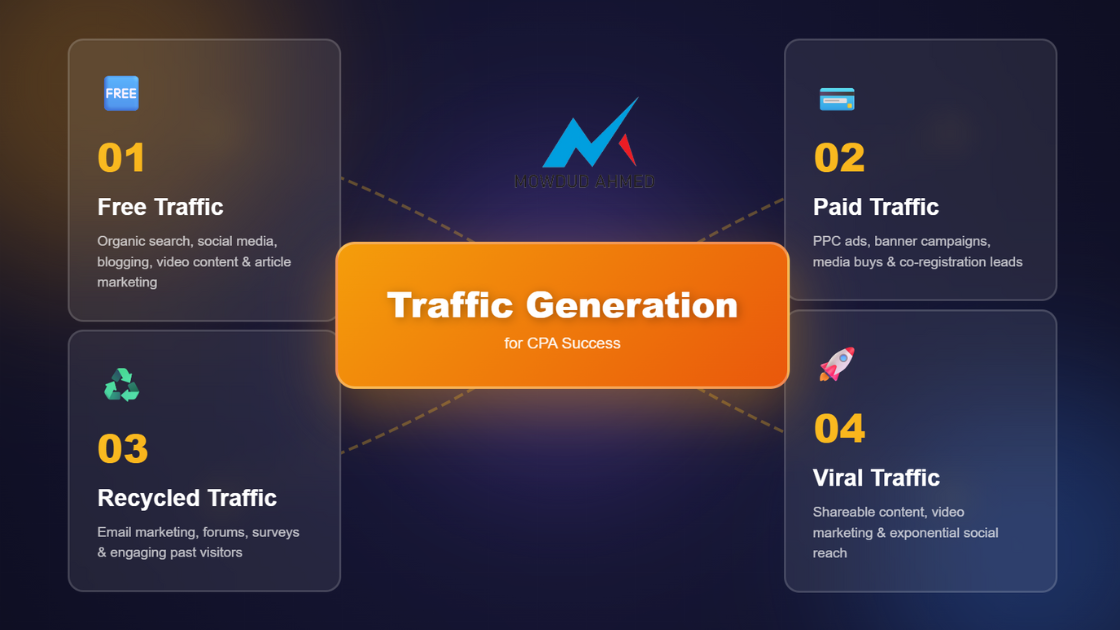
Traffic is the lifeblood of any CPA campaign. Without visitors, there are no conversions. Let’s explore the most effective traffic sources across different categories:
Free Traffic Methods
Free traffic takes time to build momentum, but once established, it creates sustainable long-term results:
Natural Search Traffic: Optimize your content for search engines through strategic meta-tags, image optimization, and quality inbound links. While results aren’t immediate, organic traffic from Google, Yahoo, and Bing converts exceptionally well because users are actively searching for solutions. To maximize your organic reach, learn proven strategies on how to drive more traffic from Google in 2026 with our comprehensive step-by-step guide.
Social Media Traffic: Leverage Web 2.0 platforms to drive both direct and indirect traffic. You can link directly to CPA offers or use social platforms to build quality backlinks that improve your overall search visibility. Platforms like Instagram, TikTok, and YouTube have become dominant—roughly 25% of affiliate traffic now comes from social media platforms.
Article Writing Traffic: Create valuable content for major article directories. This positions you as an authority while attracting targeted visitors interested in your niche. For more guidance on effective content creation, check out resources at Content Marketing Institute.
Blogging Traffic: Search engines reward consistently updated, valuable blog content with higher rankings. Blogging also builds trust and establishes your expertise in your chosen niche.
Video Traffic: Video content is projected to account for 55% of all affiliate traffic by 2025. Upload content to YouTube, Google Videos, and Yahoo Videos, then share across your networks to maximize reach.
Joint Venture Traffic: Partner with others in your niche to promote the same CPA offer. Hundreds of JV partners advertising simultaneously can dramatically increase traffic and conversions.
Paid Traffic Strategies
When you need immediate results, paid traffic delivers. However, it requires strategic investment:
Pay Per Click Search Engine Traffic: Platforms like Google Ads let you decide commission rates for visits directed to specific pages. Success requires careful keyword research and continuous optimization.
Pay Per View Traffic: This allows precise control over where and how your ads appear on selected websites and blogs, giving you targeted exposure to relevant audiences.
Co-registration Traffic: Purchase leads from reputable companies that can deliver substantial volumes—sometimes 100,000+ daily leads. This scalability makes it attractive for experienced marketers with proven funnels.
Banner Traffic: Create compelling banners with killer headlines, engaging images, and clear calls to action. Well-designed banner campaigns can significantly increase click-through rates and traffic volume.
Media Buys: This works best with thoroughly tested landing pages. While media buying can generate massive traffic volumes, costs can be substantial, so ROI testing is crucial.
Recycled Traffic Opportunities
Don’t overlook your existing database. Past customers and leads represent warm traffic that’s already familiar with you:
Email Traffic: Timing matters—send emails when click-through rates peak and redirect recipients to advertiser websites. Use pop-up windows strategically to capture attention and increase opt-in rates.
Forum Traffic: Engage past visitors through community discussions related to your niche. Active forums encourage repeat visits and build ongoing relationships.
Surveys and Polls: People love sharing opinions. Engaging visitors through surveys motivates them to return for results, creating multiple touchpoints.
Viral Traffic Magic
Viral traffic is perhaps the most powerful yet unpredictable source. Create excellent video ad copy for your CPA offer with a clear call to action, then share it across your website, video channels, social media, and personal networks. When visitors find value, they share—creating exponential reach at minimal cost.
Scaling Your CPA Marketing Campaign
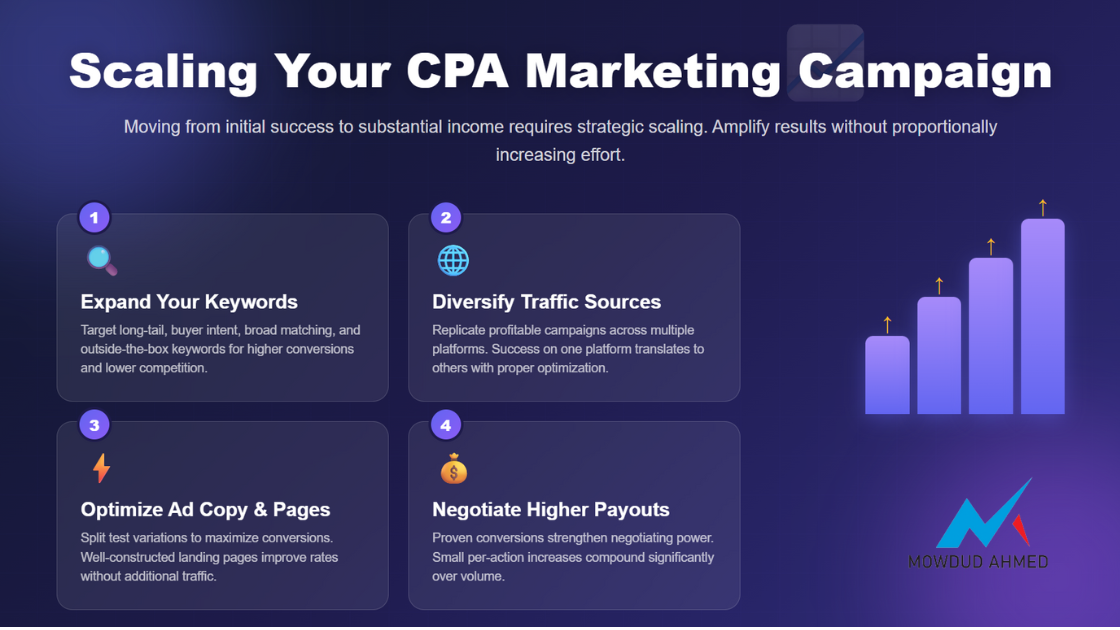
Moving from initial success to substantial income requires strategic scaling. Here’s how to amplify results without proportionally increasing effort:
Expand Your Keywords
Long-tail Keywords: These longer, more specific phrases target users closer to making purchase decisions. They typically have less competition and higher conversion rates.
Buyer Keywords: Focus on keywords that indicate purchase intent. These are the “bread and butter” of search engine marketing, attracting visitors with money ready to spend.
Broad Matching Keywords: Allow your ads to appear for relevant keyword variations, expanding reach while maintaining relevance to your core offering.
Outside-the-Box Keywords: Look at similar industries for keyword inspiration. Creative keyword research often uncovers low-competition, high-value opportunities competitors miss.
Diversify Traffic Sources
If you’ve built a profitable campaign on one platform, replicate it across others. Success on Yahoo can translate to Google, Bing, and Ask.com with proper optimization. Each new platform dramatically increases traffic potential.
Optimize Ad Copy and Landing Pages
Split testing is non-negotiable for maximizing conversions. Test different ad copy variations to identify higher click-through rates. Similarly, well-constructed landing pages that reduce friction and emphasize benefits can dramatically improve conversion rates without additional traffic investment.
Negotiate Higher Payouts
Once you’ve proven your ability to drive quality conversions, contact your affiliate manager about increased payouts. Research what other networks offer for identical products—this data strengthens your negotiating position. Even small per-action increases compound significantly over volume.
Effective Promotion Strategies
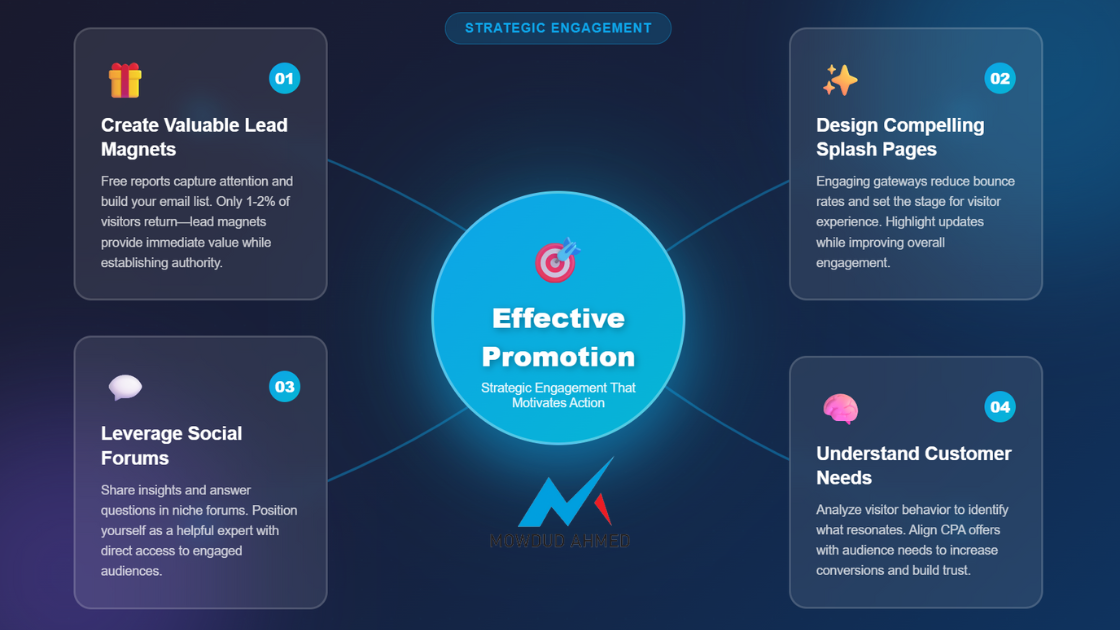
Success in CPA marketing isn’t just about traffic—it’s about strategic engagement that motivates action:
Create Valuable Lead Magnets
Free giveaway reports capture attention effectively. Research shows that only 1-2% of visitors who leave without taking action ever return. Lead magnets provide immediate value while building your email list. For example, if you’re in healthcare, offering a free report on “Managing Weight After 40” addresses a specific pain point while establishing your authority.
Design Compelling Splash Pages
A splash page acts as an engaging gateway before visitors see your main content. Whether using flash animations or visual imagery, splash pages reduce bounce rates while highlighting important updates or news. They set the stage for what visitors will experience and can significantly improve engagement rates.
Leverage Social Forums
Participate in forums within your niche to share insights, answer questions, and subtly promote relevant offers. Forums provide direct access to engaged, interested audiences while positioning you as a helpful expert rather than just another marketer.
Understand Customer Needs Deeply
Analyze visitor behavior to identify exactly what your audience needs. When you’ve run a website for a while, patterns emerge showing what resonates. Choose and promote CPA offers that align perfectly with these identified needs. This alignment increases conversions while building trust and loyalty.
Video Marketing for CPA Success
Video has become essential for modern CPA campaigns. With video content projected to account for 55% of all affiliate traffic by 2025, mastering this medium isn’t optional.
Creating Effective CPA Videos
Your video should be concise and valuable—provide tips, facts, demonstrations, or dos and don’ts that genuinely help viewers. Include a clear call to action at the end (e.g., “Click here for more information” or “Subscribe to learn more”).
Humanize your content by showing your face or adding voiceover—personal touches build trust and connection. Tag videos properly with relevant keywords to improve discoverability across search engines.
Distribution Platforms
Upload to multiple platforms for maximum reach: YouTube, Google Videos, Yahoo Videos, Viddler, Metacafe, MySpace Videos, and Photobucket. Tools like Madgicx and TrafficGeyser streamline multi-platform distribution.
Video Creation Tools
Use platforms like GoAnimate, Viewblix, Camtasia, Stupeflix, or Animoto to create professional-looking videos without extensive technical skills. These tools democratize video production, making it accessible regardless of budget.
Generating Authentic Leads
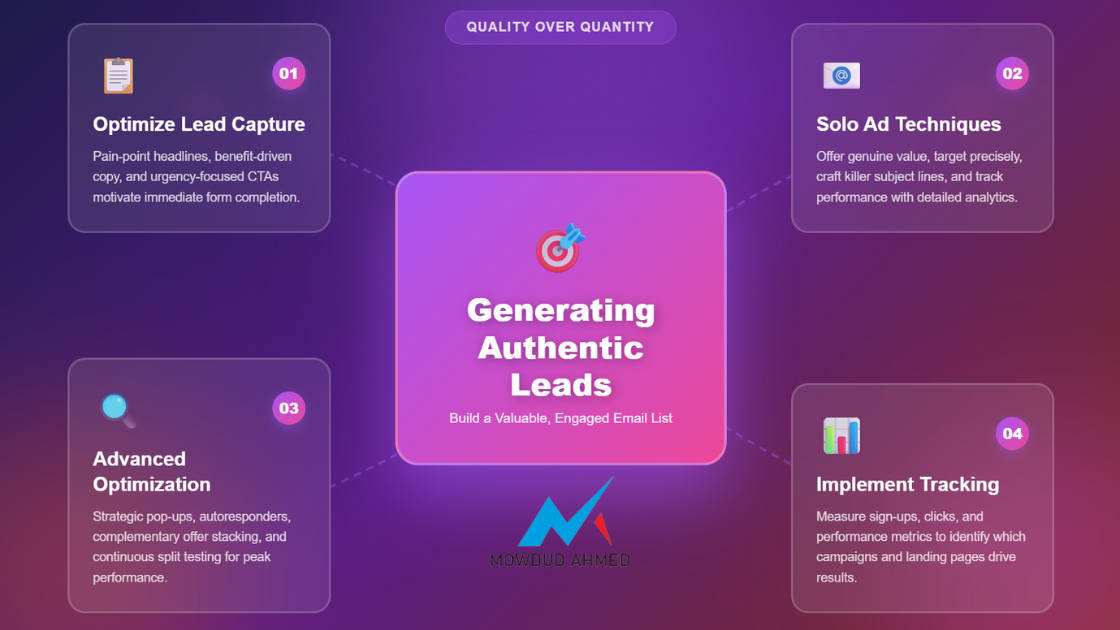
Lead quality matters more than quantity in CPA marketing. Here’s how to build a valuable, engaged email list:
Optimize Your Lead Capture Process
Create landing pages with pain-point-focused headlines that emphasize benefits and promises. Include web forms with specific calls to action and urgency-driven body copy that motivates immediate completion.
Solo Ad Techniques
Offer Genuine Value: Provide free gifts, bonuses, webinars, reports, e-courses, or consultations to motivate sign-ups. People exchange information willingly when they receive clear value.
Target Precisely: Select email ad copy that matches your specific audience for each CPA offer. Demographic and geographic targeting ensures you’re reaching people most likely to convert.
Optimize Landing Pages: Include multiple links in email copy, but direct all traffic to one specific URL. Focused landing pages convert better than scattered approaches.
Craft Killer Subject Lines: Your subject line determines whether emails get opened. Use title generator tools if needed—first impressions matter enormously in email marketing.
Run Multiple Ads: Test different offers and subject lines within newsletters to identify what resonates best with your audience.
Implement Tracking: Use traceable links to measure sign-ups, clicks, and overall performance. Tools like ClickMagick provide detailed analytics showing which campaigns, landing pages, and newsletters drive results.
Advanced Optimization Tactics
Use pop-up windows when emails redirect to landing pages—strategically timed pop-ups can significantly increase opt-in rates. Ensure all content stays relevant to your offers, stack complementary offers when appropriate, leverage autoresponders for automated follow-up, and continuously split test elements to improve performance.
Building Massive Income Through CPA Marketing
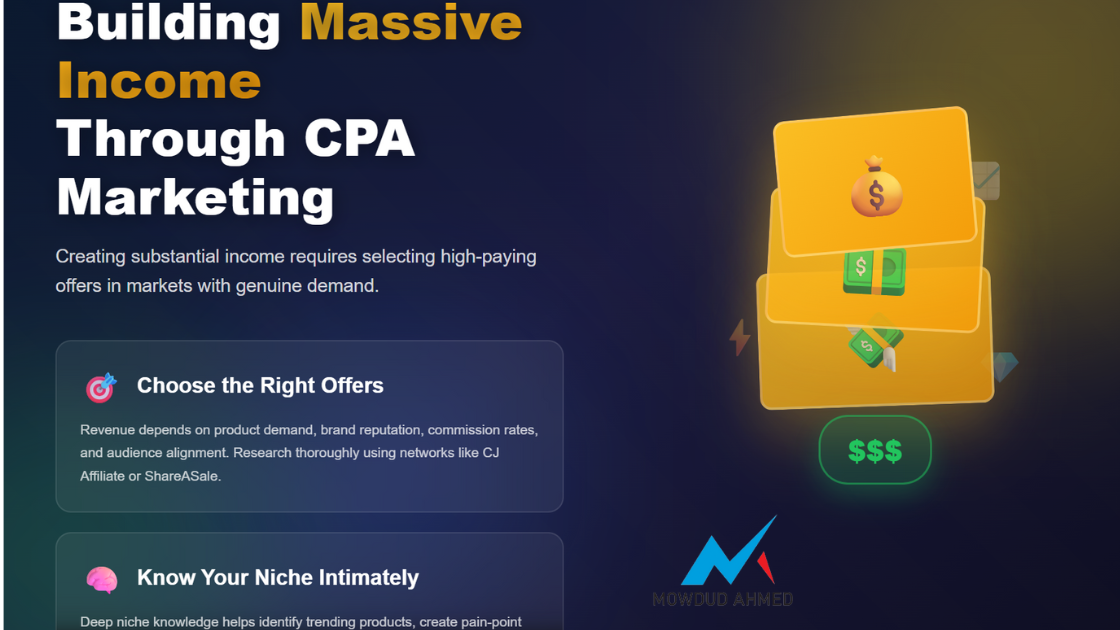
Creating substantial income requires selecting high-paying offers in markets with genuine demand:
Choose the Right Offers
Your revenue depends on multiple factors: product demand, brand reputation, commission rates, and audience alignment. Choosing a high-paying offer in a low-demand niche yields poor results. Conversely, promoting in-demand products with low commissions limits earning potential.
Research thoroughly before committing to any offer. Use networks like CJ Affiliate or ShareASale to compare offers, read reviews, and analyze conversion data.
Know Your Niche Intimately
Deep niche knowledge empowers you to make smarter, strategic decisions that connect with the right audience. When you truly understand your niche, you can spot opportunities early, create content that genuinely resonates, and position yourself as a trusted authority.
As I explain in this video, Unlock Your Niche: The Secret to Success!, niche clarity helps you identify trending products before markets become saturated, craft content that addresses real pain points, and choose keywords with strong commercial intent. Over time, this authority-driven approach builds trust, drives repeat traffic, and streamlines your earnings while removing unnecessary obstacles on your path to success.
CPA Marketing for Small Businesses
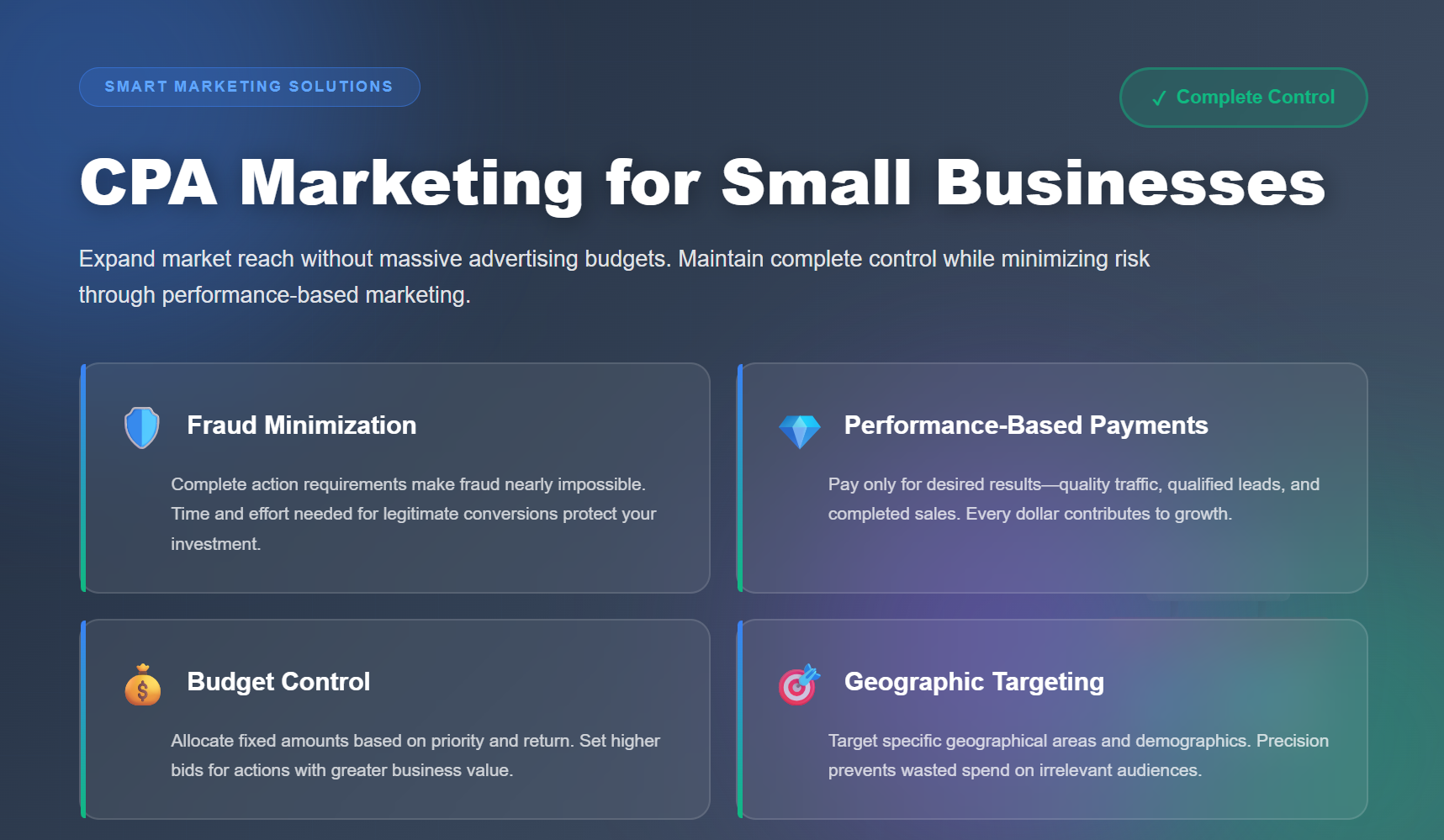
Small businesses can leverage CPA marketing to expand market reach without massive advertising budgets. As an advertiser, you maintain complete control while minimizing risk:
Key Advantages
Fraud Minimization: CPA marketing’s requirement for complete actions (surveys, forms, lead capturing) makes fraud nearly impossible. The time and effort required to fake legitimate conversions protects your investment.
Performance-Based Payments: You pay only for desired results—quality traffic, qualified leads, and completed sales. Every dollar spent directly contributes to business growth.
Budget Control: Allocate fixed amounts to different CPA offers based on priority and potential return. Set higher bids for actions with higher completion probabilities or greater business value.
Geographic Targeting: For location-specific businesses, target traffic to specific geographical areas and demographics. This precision prevents wasted spend on irrelevant audiences.
Implementation Best Practices
Track and measure campaign performance regularly. Make data-driven adjustments to optimize ROI continuously. Test different action types, payout levels, and targeting parameters to identify your most profitable configurations.
Essential Do’s and Don’ts
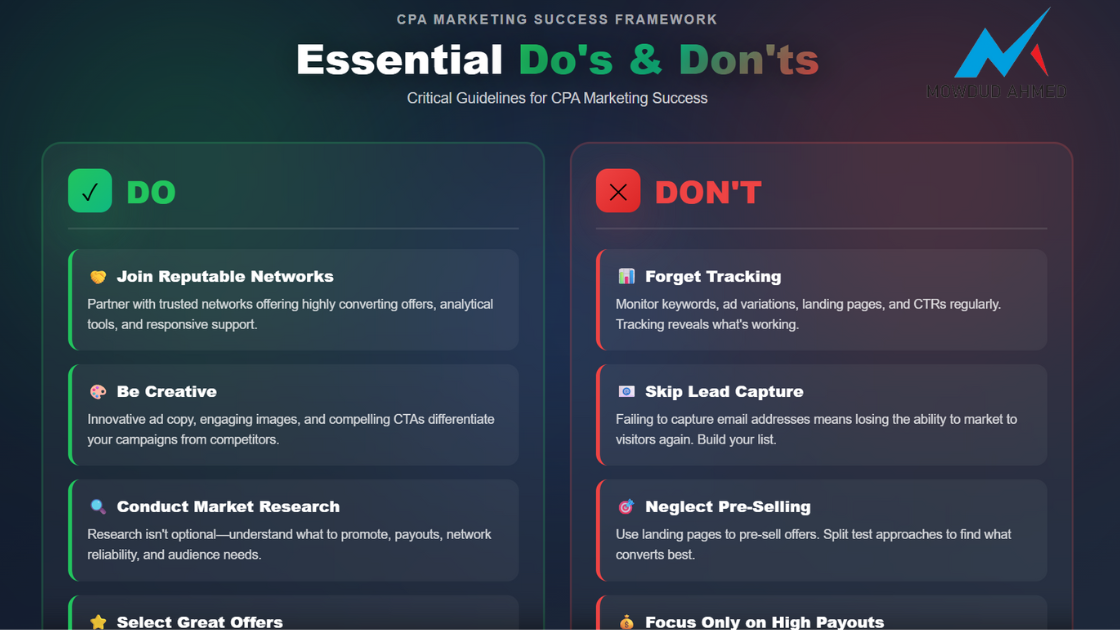
DO:
Join Reputable CPA Networks: Partner with trusted networks offering highly converting offers, analytical tools, and responsive support. Quality networks make the difference between frustration and success.
Be Creative: Don’t restrict yourself to templates or standard approaches. Innovative ad copy, engaging images, and compelling calls to action differentiate your campaigns from competitors.
Conduct Market Research: Understand what to promote, which offers provide higher payouts, which networks are most reliable, and what your audience truly wants. Research isn’t optional—it’s foundational.
Select Great Offers: Promote products your audience actually needs and wants. Valuable offers make promotion easier, attract more traffic, and increase earnings naturally.
DON’T:
Forget Tracking: No campaign works optimally forever. Monitor keywords, ad variations, landing pages, and click-through rates regularly. Tracking reveals what’s working and what needs adjustment.
Skip Lead Capture: Even with high-converting offers and great click-through rates, failing to capture email addresses means losing the ability to market to those visitors again. Build your list alongside promoting offers.
Neglect Pre-Selling: Use landing pages to pre-sell offers before sending traffic to advertiser pages. Split test different approaches—blogging, images, colors, fonts—to find what converts best.
Focus Only on High Payouts: High-paying offers with low conversion rates earn less than moderately-paid offers that convert consistently. Evaluate offers based on expected revenue (payout × conversion rate), not just commission amounts.
Media Buying Opportunities
Media buying involves purchasing bulk advertising space from website networks for fixed periods or budgets. This strategy can be highly profitable when executed correctly:
Media Buying Advantages
- Fewer restrictions compared to major ad platforms
- Negotiable pricing and ad placement
- Access to countless websites and audiences
- Lower competition than mainstream platforms
- Complete disclosure of where ads appear
Successful Media Buying Process
Select Your Market: Choose CPA offers first, then identify relevant traffic sources matching your target demographics and geography.
Find Sites: Search for 20-30 small websites with your target audience. Use Google search, Google Ad Planner, Quantcast, forums, and domain names to discover opportunities. Evaluate traffic levels using Compete, Alexa, and similar tools.
Contact Owners: Reach out to website owners about advertising opportunities. Expect about 10-15% response rates—persistence matters.
Determine Pricing: Purchase ad slots for defined periods (typically monthly) without rotation. Calculate impressions, conversions, and ROI to determine appropriate pricing.
Test Thoroughly: Before scaling media buys, thoroughly test landing pages and ad copy. Media buying works best with proven funnels—otherwise, costs can quickly outpace returns.
Final Thoughts
CPA marketing represents one of the most strategic, accountable ways to generate online income in 2025. With the global affiliate marketing industry valued at $18.5 billion and expected to approach $22 billion by 2027, opportunities continue expanding for marketers who approach this strategically.
Success requires understanding your audience deeply, choosing offers that genuinely solve problems, diversifying traffic sources, continuously testing and optimizing, and building relationships with quality networks and affiliate managers.
Whether you’re just starting or looking to scale existing campaigns, the principles remain consistent: provide value, track everything, optimize relentlessly, and always put your audience’s needs first.
The CPA marketing landscape rewards those who combine strategic thinking with consistent execution. Start small, test thoroughly, scale what works, and never stop learning. Your next profitable campaign might be just one optimized landing page away.
Ready to transform your digital marketing strategy? Start by selecting one CPA network, choosing a single offer aligned with your audience’s needs, and creating your first campaign today. The best time to start was yesterday—the second best time is now.