
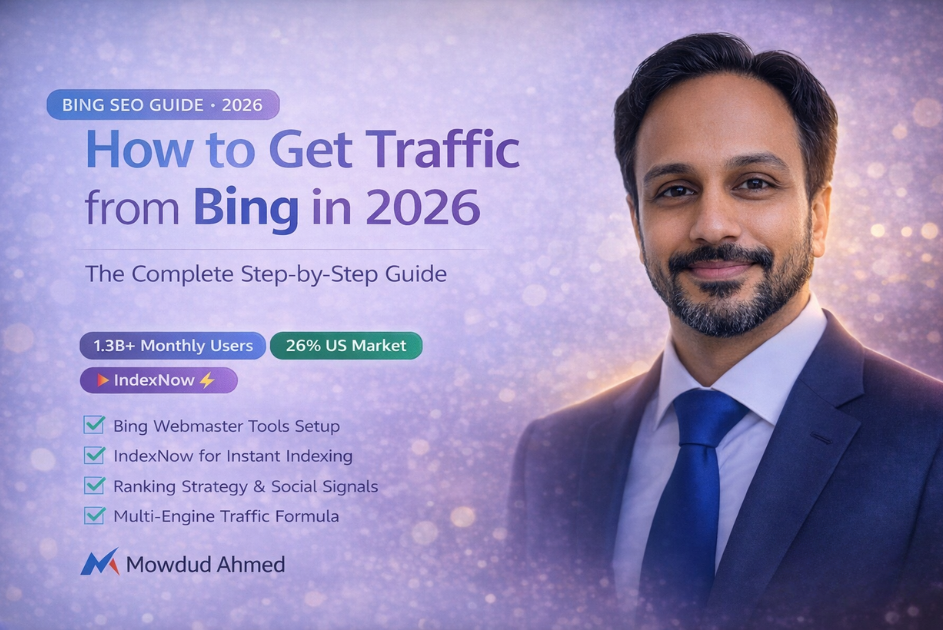
You’ve spent months perfecting your content, building backlinks, and obsessing over Google’s latest core updates — only to wake up one morning and watch your rankings disappear overnight. It’s frustrating, expensive, and honestly, completely avoidable. The secret that most bloggers and marketers are sleeping on? Learning how to get traffic from Bing in 2026 is one of the smartest moves you can make for your online business right now — and this guide will show you exactly how to do it, step by step.
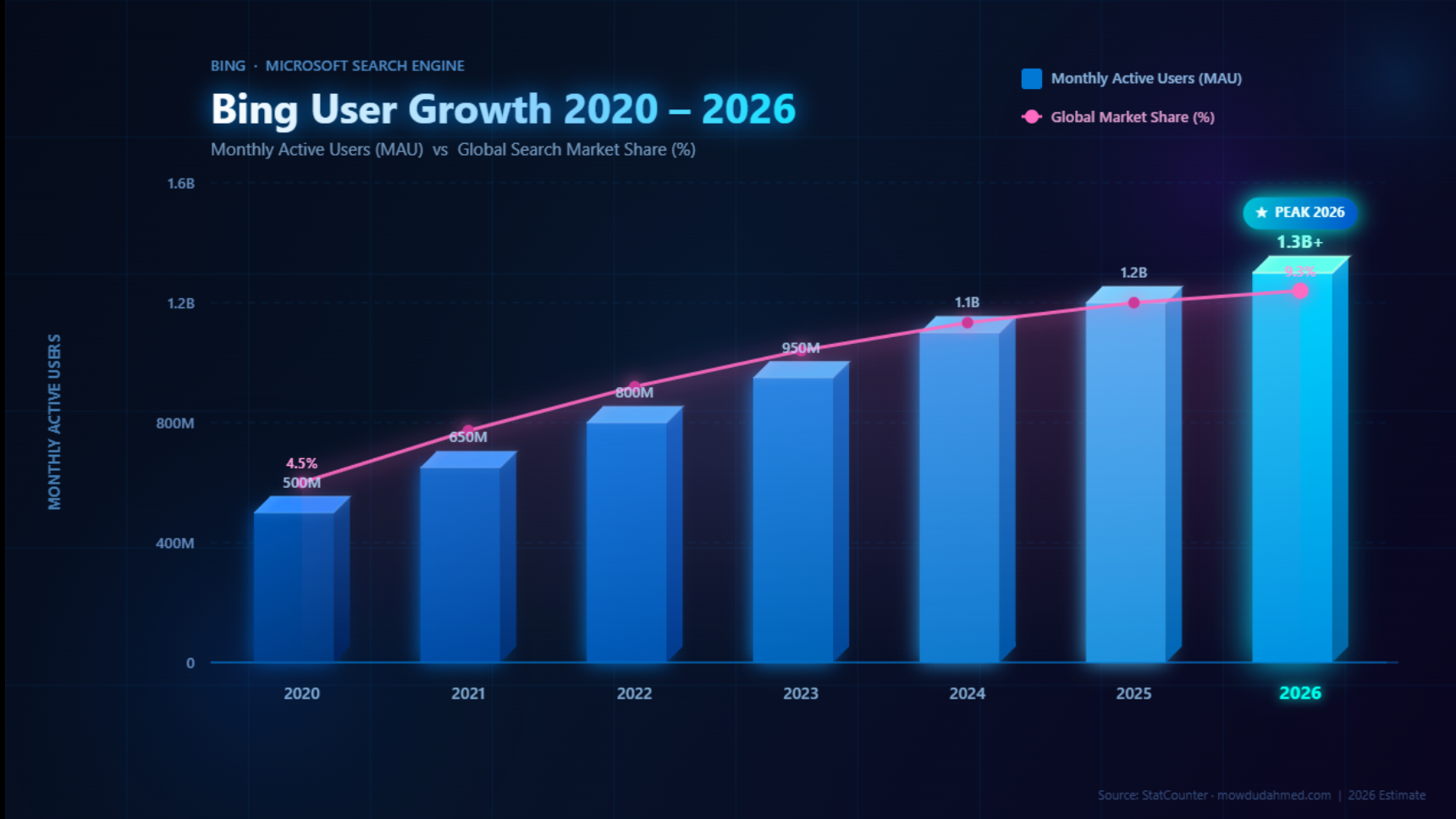
1.3B+ Monthly active users on Bing — and the number keeps growing in 2026
Here’s the thing nobody talks about: Bing now powers Microsoft Edge, Cortana, ChatGPT-integrated search, and even parts of Yahoo Search. That’s a combined audience of over a billion searches per month. While everyone fights tooth and nail for Google’s top spots, savvy marketers are quietly scooping up high-intent, low-competition Bing traffic — and converting it at incredible rates.
In this guide, we’re going to break down the full strategy — from setting up Bing Webmaster Tools from scratch, to using the IndexNow protocol, to building a ranking strategy that actually sticks in 2026. Let’s get into it.
Why Bing Is the Underrated Traffic Goldmine You’re Ignoring in 2026
Before we dive into tactics, let’s address the elephant in the room: “Bing? Really? Does anyone actually use it?”
Yes — and more people than you think. According to StatCounter’s latest data, Bing holds over 9% of the global search engine market share. In the United States alone, that number climbs above 26%. And here’s what makes that interesting from an SEO standpoint:
- 🔵 Bing users skew older (35–65) — meaning higher disposable income and stronger purchase intent
- 🔵 Lower competition — most brands focus exclusively on Google, leaving Bing’s top spots wide open
- 🔵 Microsoft’s AI integration — Bing is now embedded directly into Microsoft Copilot and Windows 11, pushing AI-driven traffic to indexed content
- 🔵 Faster results — Bing’s IndexNow protocol (more on this below) lets pages get indexed within hours, not weeks
- 🔵 Cost-effective advertising — Microsoft Ads on Bing typically have a lower CPC than Google Ads, meaning more ROI per dollar spent
How to Get Traffic from Bing in 2026: Start with Bing Webmaster Tools Setup
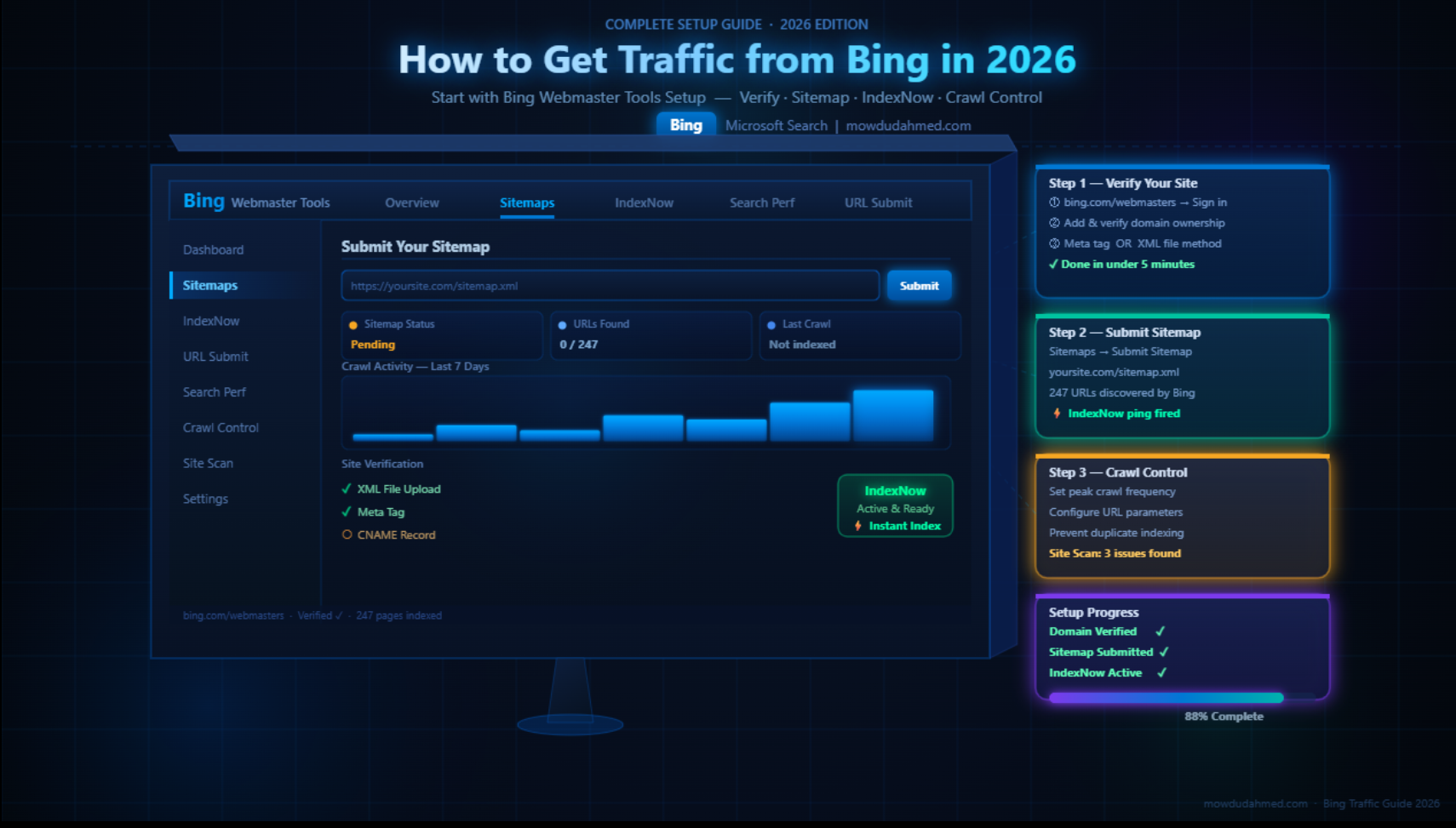
The very first thing you need to do — and most bloggers skip this entirely — is claim and verify your website on Bing Webmaster Tools. Without this, you’re essentially invisible to Bing’s crawlers. It’s free, it takes about 10 minutes, and it unlocks a powerful dashboard that rivals Google Search Console in many ways.
Create Your Bing Webmaster Tools Account
Head over to bing.com/webmasters and sign in with your Microsoft account (or create one for free). If you already have a Google Search Console account, you can import your site data directly from GSC — this saves a ton of time and pulls in your existing sitemap automatically.
Verify Your Website Ownership
Bing gives you three verification methods:
- XML file upload — Download the file and upload it to your site’s root folder
- Meta tag — Paste a small snippet into your site’s
<head>section - CNAME record — Add a DNS record through your domain registrar (best for large sites)
For WordPress users, the meta tag method via Yoast SEO or RankMath is the easiest — just paste the code into the “Webmaster Tools” section of your SEO plugin.
Submit Your XML Sitemap
Once verified, go to Sitemaps → Submit Sitemap and enter your sitemap URL (typically yoursite.com/sitemap.xml). This tells Bing exactly which pages exist on your website and helps it crawl them efficiently. Submit your sitemap within 24 hours of setting up your account — this alone can cut your indexing time dramatically.
Configure Crawl Control and URL Parameters
Under the Configuration menu, you’ll find Crawl Control settings. Set your crawl frequency to peak hours when your server has the most available bandwidth. Also configure URL parameters to prevent duplicate content issues — something Bing is particularly sensitive about compared to Google.
Pro Tip: Enable Bing’s Site Scan tool after setup. It automatically audits your site for SEO issues like broken links, missing meta descriptions, and slow page speed — and gives you a prioritized fix list. This is genuinely one of the most underrated free SEO tools available in 2026.
Use IndexNow to Supercharge Your Bing Indexing Speed in 2026
Here’s where things get really exciting. One of the biggest advantages Bing has over Google right now is the IndexNow protocol — and if you’re not using it, you’re leaving serious traffic on the table.
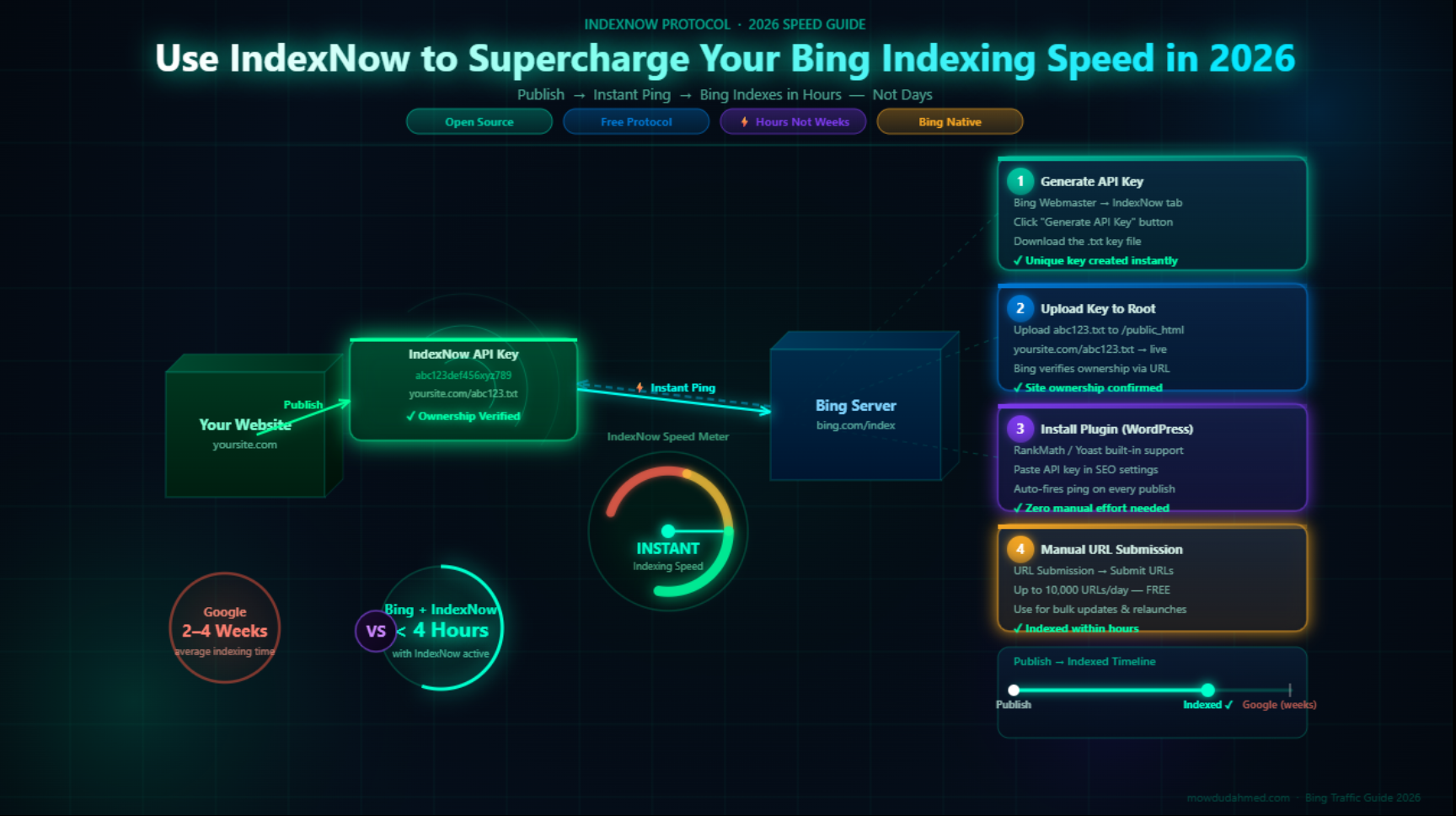
IndexNow is an open-source protocol that allows you to instantly notify search engines whenever you publish or update a piece of content. Instead of waiting for a crawler to discover your new post (which can take days or even weeks on Google), IndexNow pings Bing directly and says: “Hey, this URL just changed — come check it out.”
Bing was one of the founding members of the IndexNow initiative, and in 2026, it remains the search engine that implements it most aggressively. Results are often indexed within hours of submission.
How to Set Up IndexNow on Your Website
Generate Your IndexNow API Key
Go to your Bing Webmaster Tools dashboard and navigate to IndexNow under the left-hand menu. Click “Generate API Key.” Bing will create a unique key string — download the corresponding .txt file it creates.
Upload the Key File to Your Website Root
Upload the downloaded key file (e.g., abc123def456.txt) to your website’s root directory so it’s accessible at yoursite.com/abc123def456.txt. This proves to Bing that you own the site.
Install an IndexNow Plugin (WordPress Users)
If you’re on WordPress, install the IndexNow for WordPress plugin or use RankMath/Yoast’s built-in IndexNow integration. Once connected to your API key, every time you publish or update a post, it automatically fires an IndexNow ping to Bing. Zero manual effort required.
Manually Submit URLs When Needed
You can also submit URLs manually inside Bing Webmaster Tools under URL Submission → Submit URLs. You get up to 10,000 free URL submissions per day — more than enough for most websites. Use this when you’re doing bulk content updates or relaunching old posts.
Bing SEO Ranking Strategy: How to Get Traffic from Bing in 2026 Consistently
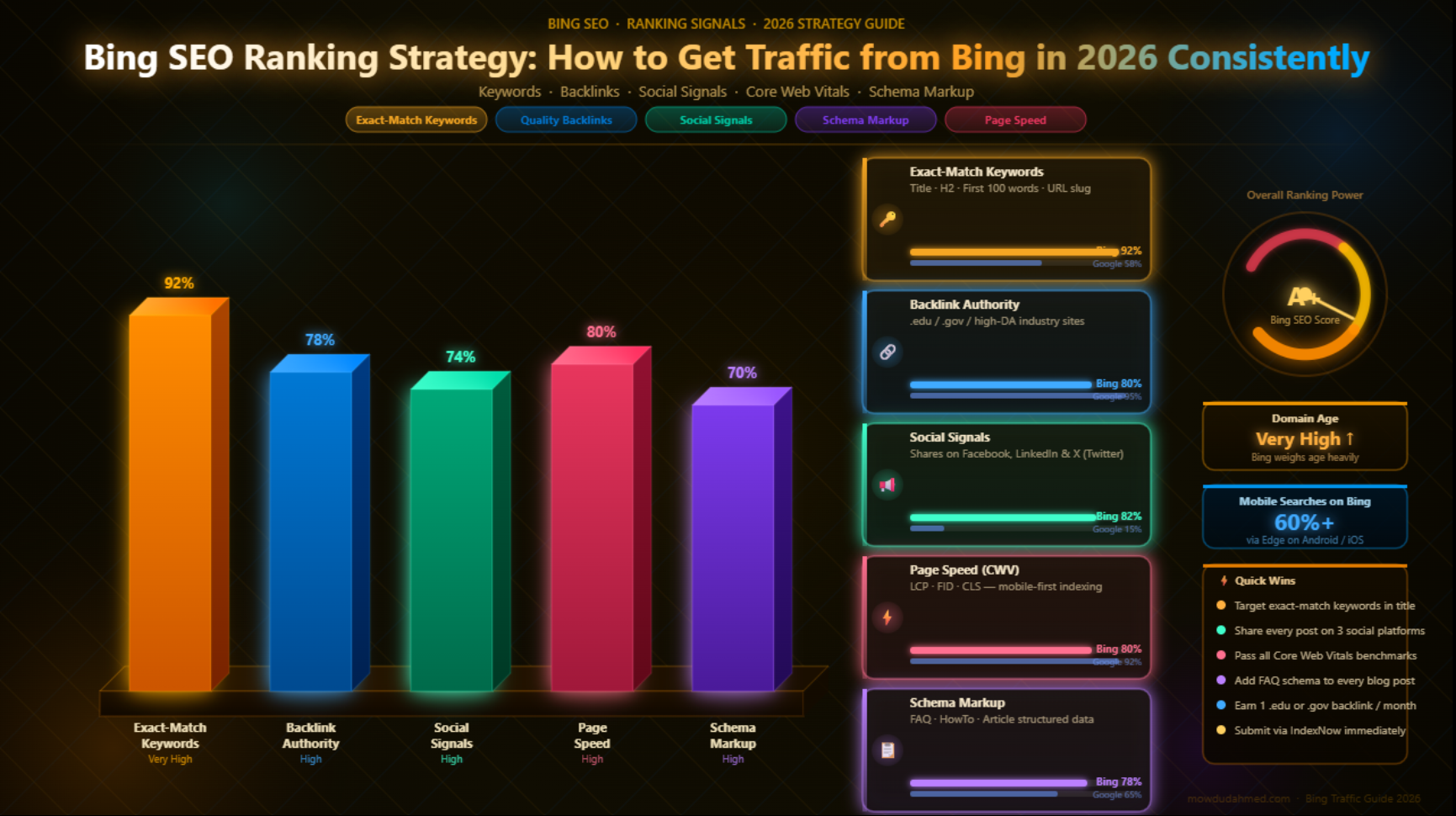
Getting indexed is just the beginning. To consistently rank and drive traffic from Bing in 2026, you need to understand what Bing’s algorithm actually rewards. While it shares some DNA with Google, Bing has its own distinct ranking signals — and knowing them is your biggest competitive edge.
1. On-Page SEO: Bing Still Loves Exact Match Keywords
Unlike Google, which has become sophisticated at understanding semantic variations, Bing’s algorithm still places heavy emphasis on exact-match keyword presence in key locations. Make sure your target keyword appears in:
- The page title (ideally within the first 60 characters)
- The first paragraph of your content (within the first 100 words)
- At least one H2 subheading
- The meta description
- The URL slug
- Naturally throughout the body content (aim for 1–2% keyword density)
2. Backlinks Still Matter — But Quality Over Quantity
Bing actually places a higher value on backlink authority than Google in some contexts. A single high-DA link from a trusted .edu, .gov, or well-established industry site can move the needle significantly on Bing. Focus your outreach on quality link building strategies rather than volume plays.
3. Social Signals Are a Real Ranking Factor on Bing
This is a major difference from Google. Bing openly acknowledges that social signals — shares, likes, and mentions on Facebook, LinkedIn, and X (Twitter) — influence its rankings. Promote every piece of content you publish on social media immediately after publishing. This isn’t just for referral traffic; it’s directly feeding Bing’s ranking algorithm.
4. Page Experience and Core Web Vitals
Bing adopted Core Web Vitals metrics in its ranking algorithm, prioritizing fast-loading, mobile-responsive, stable pages. Use Google PageSpeed Insights (yes, Google’s tool works fine for this) to identify and fix performance issues — what helps your Google ranking here will equally help your Bing ranking.
5. Structured Data and Schema Markup
Implementing schema markup (FAQ schema, How-To schema, Article schema) gives Bing rich context about your content and can unlock rich snippet appearances in search results. These enhanced listings dramatically increase click-through rates. Use Schema.org markup and validate it with Microsoft’s own Rich Results Tester in Webmaster Tools.
| Ranking Factor | Bing Weight | Google Weight |
|---|---|---|
| Exact-Match Keywords | 🔵🔵🔵🔵🔵 Very High | 🔵🔵🔵 Medium |
| Backlink Authority | 🔵🔵🔵🔵 High | 🔵🔵🔵🔵🔵 Very High |
| Social Signals | 🔵🔵🔵🔵 High | 🔵 Very Low |
| Page Speed | 🔵🔵🔵🔵 High | 🔵🔵🔵🔵🔵 Very High |
| Age of Domain | 🔵🔵🔵🔵🔵 Very High | 🔵🔵🔵 Medium |
| Schema Markup | 🔵🔵🔵🔵 High | 🔵🔵🔵 Medium |
Build a Multi-Engine Traffic Strategy: Bing + Google + Beyond
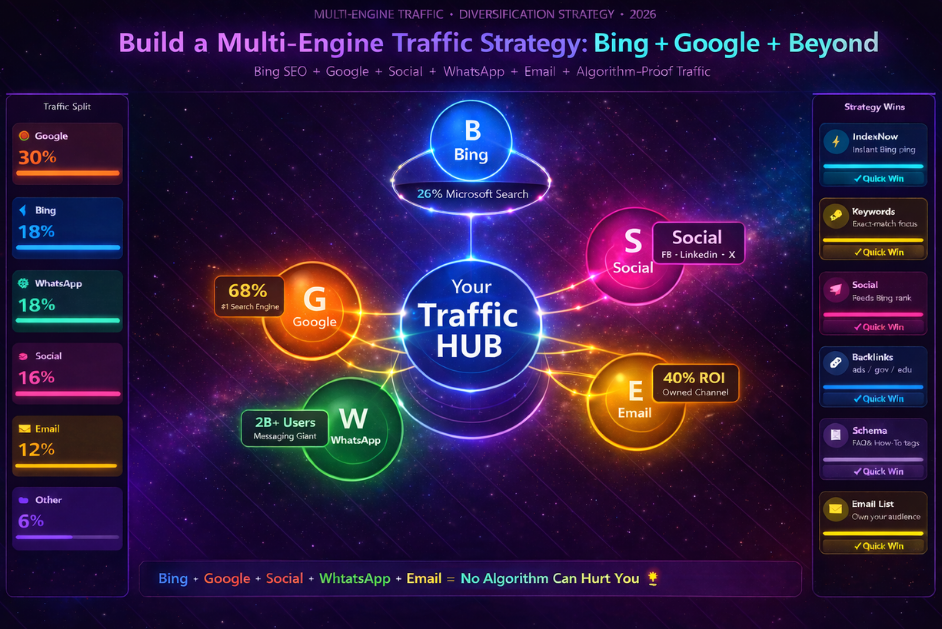
The smartest content creators in 2026 don’t put all their eggs in one basket. If you’re already working on driving traffic from Google, the good news is that great SEO fundamentals carry over directly to Bing — you’re not starting from scratch. You’re just adding a powerful second engine.
Check out this deep-dive guide on how to drive more traffic from Google in 2026 — applying those strategies alongside the Bing tactics in this post is the most powerful combination you can build right now.
And don’t sleep on alternative traffic channels either. Social channels, especially messaging platforms, have become incredibly potent for content distribution. If you want to explore that angle, this guide on WhatsApp marketing strategies for 2026 is essential reading — particularly if you’re targeting B2C audiences in Southeast Asia, the Middle East, or Europe where WhatsApp usage is dominant.
Common Mistakes That Kill Your Bing Traffic (Avoid These!)
Before you start implementing, here are the landmines that trip up most people when they first try to get traffic from Bing in 2026:
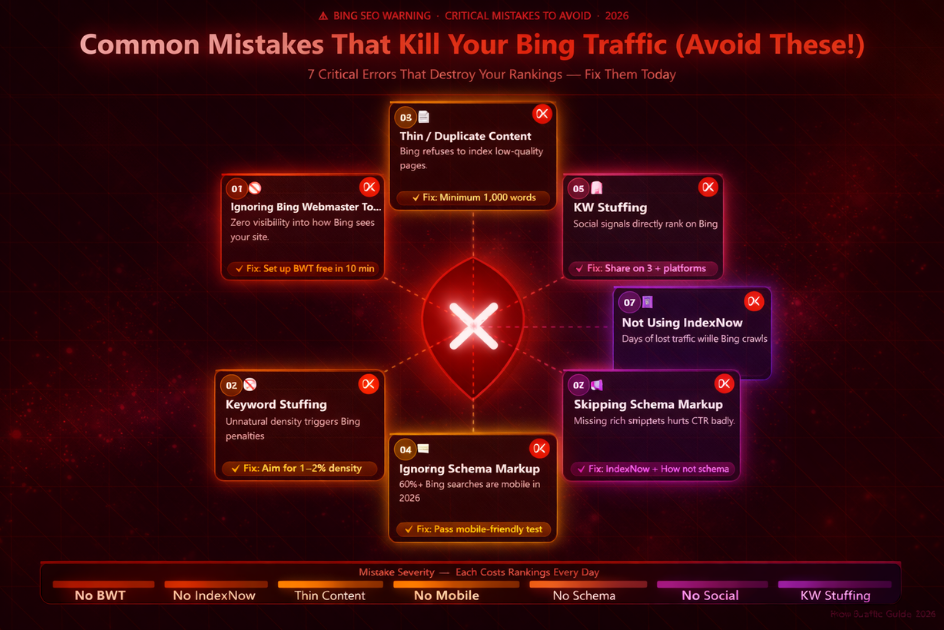
- ❌ Ignoring Bing Webmaster Tools — Not verifying your site means you have zero visibility into how Bing sees it
- ❌ Keyword stuffing — Yes, exact-match keywords matter more on Bing, but jamming them unnaturally still triggers penalties
- ❌ Thin or duplicate content — Bing is exceptionally aggressive at filtering out low-quality pages; it will simply refuse to index them
- ❌ Ignoring mobile optimization — Over 60% of Bing searches in 2026 come from mobile devices (especially through Edge on Android)
- ❌ No social promotion strategy — Remember, Bing’s algorithm counts social signals. Publishing without sharing on social is leaving ranking power behind
- ❌ Skipping schema markup — Bing heavily favors structured data in its rich result selection — this is low-hanging fruit most people ignore
- ❌ Not using IndexNow — Every day your content isn’t indexed is a day you’re not getting traffic. There’s zero reason not to use this free tool
Final Thoughts: Make Bing Part of Your 2026 Traffic Strategy Today
Here’s the honest truth: most of your competitors aren’t even thinking about Bing right now. That’s not a warning — that’s an opportunity. While they’re locked in the increasingly expensive, increasingly competitive Google arms race, you can build a sustainable, diversified traffic stream from Bing with significantly less effort.
To recap what we covered today on how to get traffic from Bing in 2026:
- ✅ Set up and verify your site on Bing Webmaster Tools — it’s free and takes 10 minutes
- ✅ Submit your XML sitemap and configure crawl settings for optimal indexing
- ✅ Implement IndexNow for near-instant indexing of new and updated content
- ✅ Optimize on-page SEO with exact-match keywords, schema markup, and fast page speeds
- ✅ Build quality backlinks and actively promote content on social media (this feeds Bing’s ranking signals)
- ✅ Combine your Bing strategy with Google, social, and alternative traffic channels for maximum diversification
The window is wide open right now. In 12 months, more marketers will catch on, competition will rise, and getting these quick wins will become harder. The best time to start is today.
Want More Strategies Like This?
I share in-depth tutorials, SEO breakdowns, and practical digital marketing strategies that help entrepreneurs grow smarter. Follow for step-by-step guidance, actionable ideas, and proven insights you can actually use.
If this guide helped you, stay connected for more practical growth strategies.