

Running an online business often feels less like entrepreneurship and more like managing an endless queue. A blog needs content. Leads need follow-up. Clients expect finished work. New campaigns require research, pages, emails, videos and social posts. That is why AI business automation tools have become so relevant in 2026: the best ones do more than generate text. They help organize repeatable work, surface opportunities and move projects closer to completion.
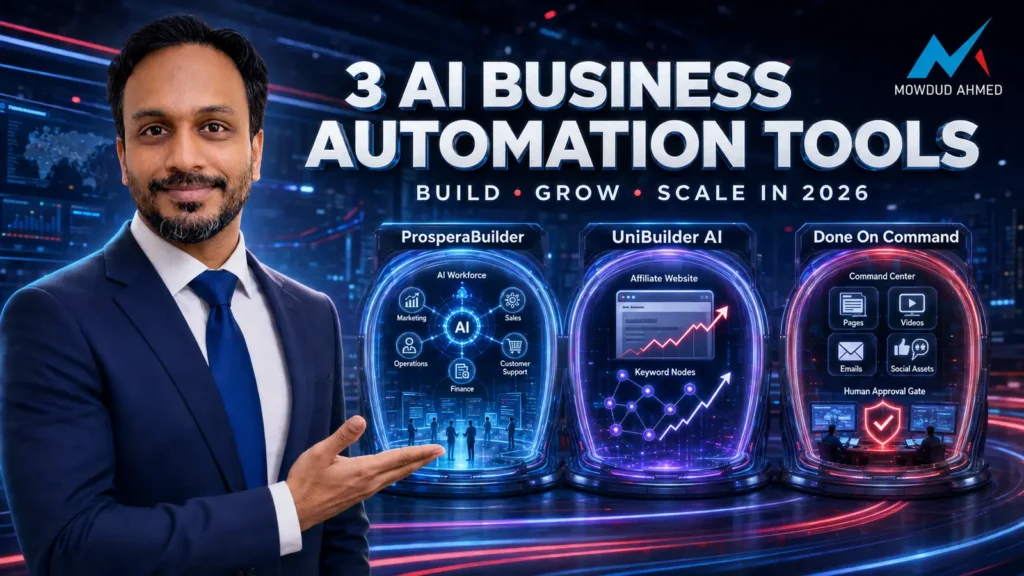
Yet every platform promises “automation,” while each automates something different. ProsperaBuilder packages specialist AI employees into ready-made business models. UniBuilder AI concentrates on cloning proven website structures and finding content opportunities. Done On Command aims to execute marketing tasks and return finished deliverables.
So, which approach fits your business?
This guide compares their features, ideal uses, commercial options and limitations. More importantly, it shows where each product belongs in a real workflow.
What Are AI Business Automation Tools?
AI business automation tools use artificial intelligence to reduce repetitive work across marketing, research, content, sales and customer operations. Instead of starting every task with a blank screen, a user gives the system a goal, business context or source material. The software then produces an output or carries out part of the workflow.
However, there is an important distinction between assistance and automation.
A basic AI assistant may draft an email, but you still copy, format and send it. An automation platform connects more steps. It might research the audience, create the campaign, preserve brand context and prepare the final assets for approval. The closer a platform gets to a usable result, the more operational value it can offer.
Demand is clearly moving in this direction. McKinsey’s 2025 global AI survey reported that more than two-thirds of respondents used AI in multiple business functions. Still, access to AI does not automatically create an advantage. Another McKinsey analysis argues that differentiation comes from redesigning offerings and business economics, not simply owning the same models as everyone else.
Therefore, a useful tool should solve a defined bottleneck. It should save measurable time, improve consistency, create a sellable output or help you act on better opportunities. Otherwise, it becomes another dashboard you rarely open.
Quick Comparison of These AI Business Automation Tools

These products overlap, but they are not direct substitutes. Think of them as three different layers of an AI-enabled business.
| Platform | Core function | Best suited to | Distinctive angle | Human role |
|---|---|---|---|---|
| ProsperaBuilder | Structures ready-made AI businesses | Beginners, marketers and service providers | Five business models with 25 specialist AI employees | Choose tasks, review outputs and package services |
| UniBuilder AI | Builds and grows affiliate-style websites | Affiliates, niche bloggers and SEO marketers | Site cloning plus an opportunity feed for keywords and content | Select the source, validate keywords and approve content |
| Done On Command | Executes marketing work across client businesses | Agencies, freelancers and local marketers | Persistent business memory and white-label delivery | Give commands, approve work and manage client quality |
In plain language, ProsperaBuilder helps you build the operation. UniBuilder AI helps you grow a website asset. Done On Command helps you execute and deliver the work.
That distinction should guide your buying decision.
ProsperaBuilder: Build Businesses With 25 AI Employees

ProsperaBuilder is built around a compelling idea: instead of opening a general chatbot and inventing every prompt, start with a pre-arranged AI company.
According to the official ProsperaBuilder information, the front-end includes five ready-made businesses covering marketing, affiliate marketing, publishing, consulting and content. Each department contains five specialist roles, creating a total of 25 AI employees.
The marketing department covers audits, email, social content and reporting. Meanwhile, the affiliate team supports research, reviews, bonuses, promotional emails and bridge pages.
This structure matters because specialization removes some prompting friction. A user does not need to decide which generic model should write a proposal or research an offer. Instead, the task is routed through a role designed for that purpose.
ProsperaBuilder also includes an AI employee builder. Consequently, users can create a custom role for a particular niche, service or client. That may be useful for a travel agency, for example, where a generic content assistant could be adapted into a package-description writer or enquiry-response specialist.
Where ProsperaBuilder Makes Sense
The platform looks most useful when you have skills but lack a clear service structure. You could choose one department, create several sample deliverables and turn them into a focused offer.
For example, an affiliate marketer could research products, outline reviews and prepare emails. A freelancer might develop reports and proposals, while a creator could assemble monthly content packages.
Do not launch five businesses at once. Start with one audience and one outcome. Then test whether the AI-generated work meets your standard.
Explore the ProsperaBuilder Commercial offer or view the complete ProsperaBuilder Bundle.
UniBuilder AI: Clone and Grow Affiliate Websites

UniBuilder AI takes a narrower route. It is not primarily a general business builder. Instead, it focuses on creating and expanding websites modeled on proven structures.
The official UniBuilder AI sales information says users can paste a website URL, clone its structure and let the system research content opportunities. Its self-learning feed scores potential topics, while the user decides what should be created.
That last point deserves attention. “Automated” should not mean “publish everything blindly.” Keyword quality, search intent, factual accuracy and originality still require judgment. Google does not reward a page simply because AI produced it. The page needs to satisfy the reader better than competing results.
UniBuilder AI’s most interesting feature is its ongoing opportunity model. Many site builders stop after producing a design. This platform aims to keep scanning for keywords, trends and fresh content angles after launch.
A Smarter Way to Use Site Cloning
Cloning should mean learning from a successful layout—not copying another publisher’s identity, protected content or brand assets. Use references to study navigation and conversion flow. Then create original content, validate every suggested keyword and add first-hand analysis. Finally, track impressions, clicks and conversions before expanding.
If you are still assembling your marketing stack, my guide to the best free AI tools for affiliate marketing beginners provides useful supporting options. You may also compare UniBuilder’s approach with my ContentRyte review, which focuses more directly on WordPress content production.
See the UniBuilder AI front-end offer or check the UniBuilder AI Bundle.
Done On Command: Execute and Deliver Marketing Work

Done On Command targets a familiar frustration: many AI tools produce a draft, then leave the operational work to you. This platform is positioned as an AI business operator that takes a command and returns a more complete deliverable.
Its official partner page describes seven areas: pages, videos, images, lead magnets, email, social media and lead management. Each business can have separate branding and stored context.
The persistent-memory angle is particularly relevant for agencies. Re-explaining a client’s colors, audience, tone and offers wastes time. A separate business memory could make recurring campaigns more consistent, although important details should still be checked before approval.
The approval step is essential. A landing page can contain a broken link. An email may make an unsupported claim. A social post might miss the brand voice. Therefore, human review remains part of the operating model.
From Software to a Client Service
Done On Command appears strongest when connected to a defined monthly service. For example, an agency could supply one campaign page, four emails, eight social posts and two videos. Clients can understand that package, and the agency can quality-check it.
The platform includes commercial rights across its tiers, according to the vendor’s current materials. White-label dashboards can also help an agency present the system under its own brand. Nevertheless, branding alone will not retain clients. Strategy, communication, reliability and measurable outcomes still matter.
Readers interested in this service model can also explore my guide to AI agents for client acquisition.
View the Done On Command Commercial offer or see the Done On Command Bundle.
AI Business Automation Tools: Features and Use Cases Compared

The fastest way to compare these AI business automation tools is to match each feature with a real business outcome.
ProsperaBuilder leads for structured services, custom AI roles and experimentation across business models. UniBuilder AI leads for niche-site setup and recurring SEO opportunities. Done On Command leads for multi-format production, retained client context and branded delivery.
There is no universal winner. If you lack an offer, ProsperaBuilder provides structure. If you need a website engine, UniBuilder AI may help. If client production is the bottleneck, Done On Command is the logical fit.
Which Tool Is Best for Affiliate Marketers?
UniBuilder AI is the most direct choice for an affiliate marketer whose main goal is organic search traffic. Its workflow connects site creation, keyword discovery and content planning. Those steps sit close to the core affiliate model: attract targeted visitors, answer buying questions and direct qualified readers toward relevant offers.
However, ProsperaBuilder may be better for campaign-focused affiliates. Its specialist roles can support product research, review outlines, promotional emails, bridge pages and bonus creation. Therefore, it fits marketers who promote launches through a list, social channels and review content.
Done On Command becomes useful when an affiliate operation already publishes across several formats. It could help turn one campaign into pages, emails, videos and social assets. Yet buying the largest system before validating traffic would be premature.
A sensible progression is simple. First, establish a niche and publishing routine. Next, measure which topics attract clicks. Finally, automate the repeated tasks that support proven results. My Super Affiliates AI review offers another perspective on building organic affiliate channels.
Which Tool Is Best for Agencies and Freelancers?
Done On Command has the clearest agency proposition because it centers on client businesses, finished assets, persistent context and white-label presentation. It can support a recurring-deliverables model rather than isolated gigs.
ProsperaBuilder is the better entry point for a freelancer who has not yet chosen a service. Its marketing, consulting and content departments can help test several deliverables. Once demand becomes clear, the freelancer can narrow the package.
UniBuilder AI suits agencies that sell affiliate sites, niche websites or SEO content systems. Still, client expectations must be managed carefully. No ethical agency should promise rankings or guaranteed income. Search performance depends on competition, authority, technical quality, content usefulness and time.
Whichever platform you choose, keep responsibilities clear. Confirm who controls the domain, content, analytics, customer data and exported assets.
Pricing, Upgrades and Commercial Rights

Launch funnels can be confusing because the entry product and bundle solve different needs. Prices may also rise or change after launch. Accordingly, treat the figures below as a structure guide and verify the checkout page.
ProsperaBuilder Pricing Approach
The vendor materials list a $37 front-end at the time of research, including the five businesses and 25 employees. Upgrades expand limits, memory, templates, agency capabilities and white-label options.
The ProsperaBuilder Commercial offer is the practical starting point for testing core workflows. Conversely, the ProsperaBuilder Bundle is aimed at buyers who expect to use the larger ecosystem.
UniBuilder AI Pricing Approach
UniBuilder AI separates its core site-growth system from the bundle. Before upgrading, check site allowances, automation limits, hosting and tier-specific features.
Start with the UniBuilder AI front-end if one focused site can prove the concept. Consider the UniBuilder AI Bundle only when its additional capacity matches your publishing plan.
Done On Command Pricing Approach
Done On Command upgrades add higher business limits, generation capacity, agency assets, reseller options and expanded hosting. Current vendor information says commercial rights are included on every tier.
The Done On Command Commercial offer suits controlled testing. The Done On Command Bundle makes more sense for an active agency that can use the extra capacity immediately.
Always read the license. Commercial, agency, reseller and white-label rights are not interchangeable. They may cover selling outputs, accounts or rebranded access under different conditions.
Pros and Cons of Each Platform

ProsperaBuilder Pros
- Clear structure for users overwhelmed by general-purpose AI
- Five different business models inside one dashboard
- Twenty-five specialist roles plus custom employee creation
- Useful for packaging content, consulting and marketing services
ProsperaBuilder Cons
- Five businesses can distract beginners from mastering one offer
- Outputs still require editing, fact-checking and positioning
- Advanced capacity and white-label features may require upgrades
UniBuilder AI Pros
- Focused workflow for affiliate and niche-site builders
- Faster structural setup using reference websites
- Ongoing keyword and content-opportunity discovery
- User approval remains part of the publishing process
UniBuilder AI Cons
- Site cloning must be handled ethically and originally
- “Low-competition” keywords still require independent validation
- Automated content does not guarantee rankings or conversions
Done On Command Pros
- Designed to move beyond drafts toward finished marketing assets
- Persistent context may reduce repeated client briefing
- Wide coverage across pages, email, video, images and social media
- Strong commercial and white-label agency positioning
Done On Command Cons
- Broad capability creates a larger quality-control burden
- Agency success still depends on strategy and client management
- Higher limits, reseller functions and expanded capacity require upgrades
Final Verdict: Which AI Business Tool Should You Choose?
Choose ProsperaBuilder if your biggest challenge is turning scattered skills into a structured offer. Its departments and specialist employees provide direction. Nevertheless, begin with one business model and one customer type.
Choose UniBuilder AI if you want to build and grow an affiliate-focused website. Its combination of structural cloning and opportunity discovery is the most SEO-oriented option here. Use it as a research and production accelerator, not a shortcut around originality.
Choose Done On Command if you already serve clients or intend to sell recurring marketing deliverables. Persistent memory, multiple production departments and white-label dashboards make it the strongest agency candidate. Even so, every public-facing asset should pass human review.
The smartest investment is not necessarily the largest bundle. It is the tool that solves a bottleneck you can name today.
Ultimately, AI business automation tools should strengthen your judgment rather than replace it. Pick one workflow, set a measurable target and review the results after 30 days. Track hours saved, assets completed, traffic generated, leads captured or client work delivered. Then expand only when the evidence supports it.
For more software reviews, affiliate strategies and AI marketing guides, visit MowdudAhmed.com.