
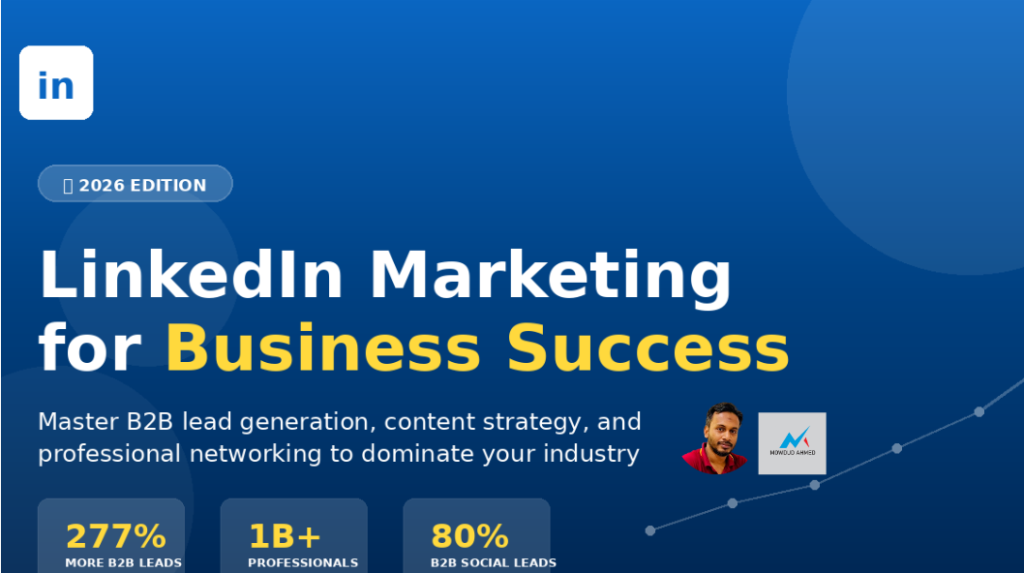
Imagine transforming your business through a platform where decision-makers actually want to engage with professional content. That’s the power of LinkedIn marketing for business in 2026.
LinkedIn has evolved far beyond a digital resume platform. With over 1 billion professionals worldwide, it’s become the ultimate ecosystem for B2B marketing, thought leadership, and strategic networking. Whether you’re a solopreneur, marketing director, or business owner, mastering LinkedIn marketing for business is no longer optional—it’s essential for sustainable growth.
This comprehensive guide reveals everything you need to dominate LinkedIn marketing, from profile optimization to advanced lead generation tactics. You’ll discover actionable strategies that industry leaders use to build authority, generate qualified leads, and create lasting business relationships.
Why LinkedIn Marketing for Business Outperforms Other Platforms
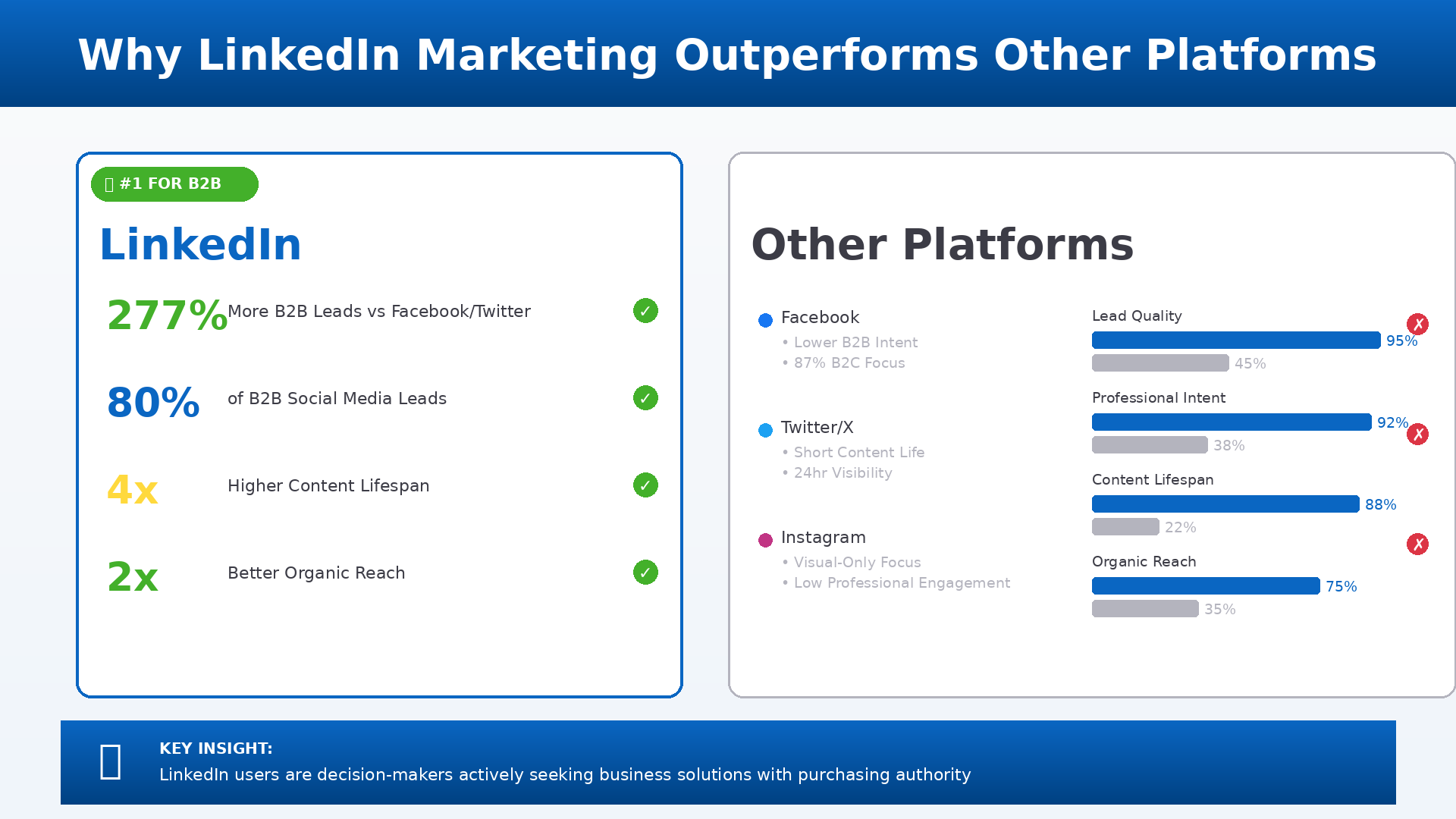
LinkedIn isn’t just another social media channel—it’s a business growth engine. According to HubSpot’s 2025 Marketing Report, LinkedIn generates 277% more leads than Facebook and Twitter combined for B2B companies.
Here’s what makes LinkedIn marketing uniquely powerful:
- High-Intent Audience: LinkedIn users are professionals actively seeking business solutions, not just browsing casually. The average user has purchasing authority and decision-making power.
- Superior Organic Reach: While other platforms throttle organic content, LinkedIn’s algorithm still rewards quality. Posts from individuals consistently outperform paid ads (source: LinkedIn Algorithm Report 2026).
- Trust-Driven Environment: Professional context creates higher credibility. Content shared on LinkedIn carries more authority than identical posts on other platforms.
- Longer Content Lifespan: Unlike the 24-hour shelf life of Instagram posts, LinkedIn content continues generating engagement for 7-10 days.
- Perfect for B2B Marketing: 80% of B2B leads generated through social media come from LinkedIn (source: LinkedIn Business Solutions).
Step 1: Define Your LinkedIn Marketing for Business Strategy
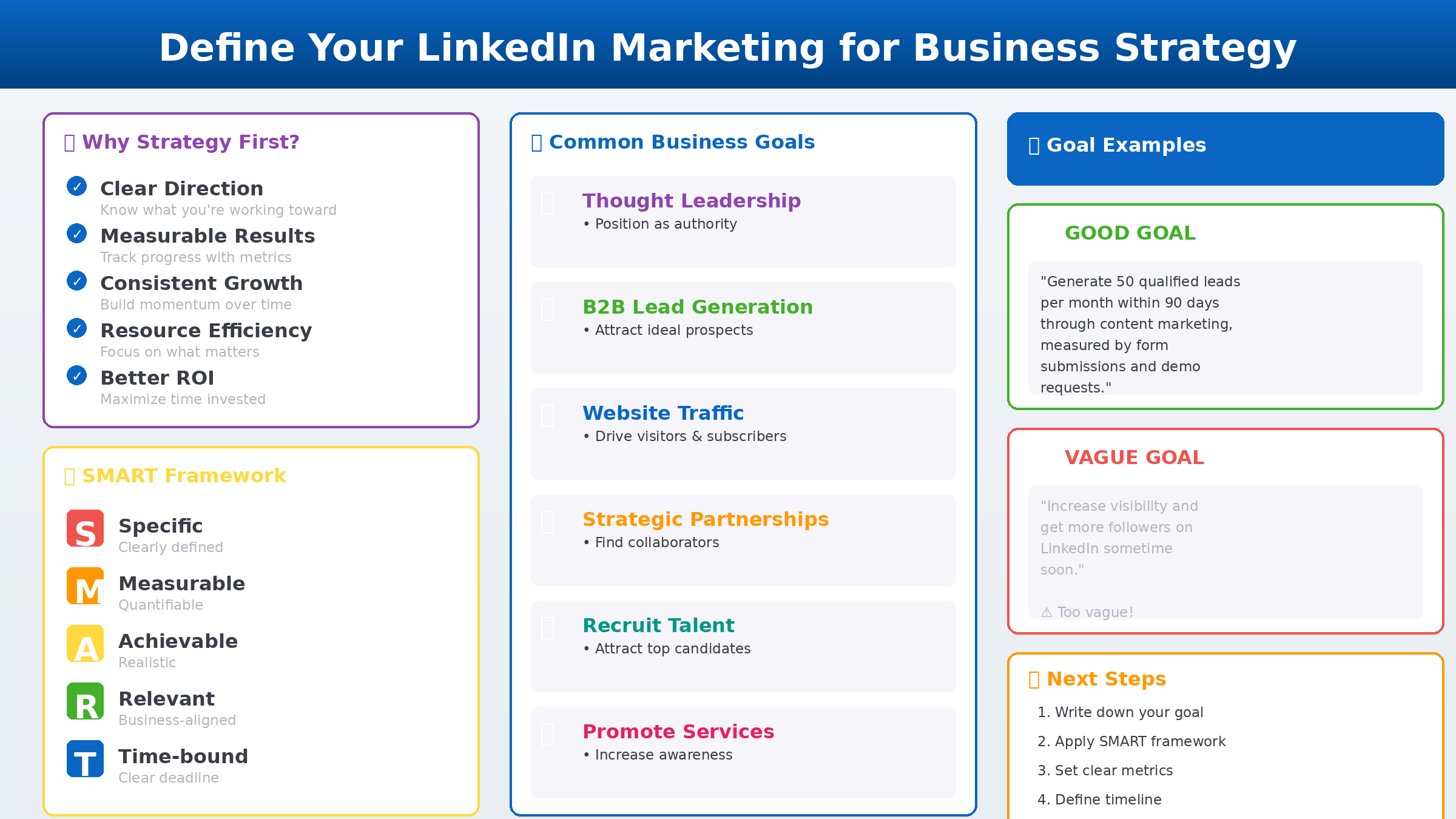
Before creating a single post, you need crystal-clear objectives. Vague goals produce vague results. Successful LinkedIn marketing for business starts with strategic clarity.
Common Business Goals on LinkedIn
- Establish Thought Leadership: Position yourself or your brand as an industry authority through consistent, valuable insights
- Generate Qualified B2B Leads: Attract decision-makers who match your ideal customer profile
- Drive Website Traffic: Convert LinkedIn engagement into blog readers, newsletter subscribers, or product demo requests
- Build Strategic Partnerships: Connect with potential collaborators, investors, or industry influencers
- Recruit Top Talent: Showcase company culture to attract high-caliber candidates
💡 Pro Insight: Document your goals using the SMART framework (Specific, Measurable, Achievable, Relevant, Time-bound). Instead of “increase visibility,” aim for “generate 50 qualified leads per month within 90 days through LinkedIn content marketing.”
For comprehensive social media marketing fundamentals that complement your LinkedIn strategy, explore this resource: How to Master Social Media Marketing.
Step 2: Optimize Your LinkedIn Profile for Maximum Business Impact
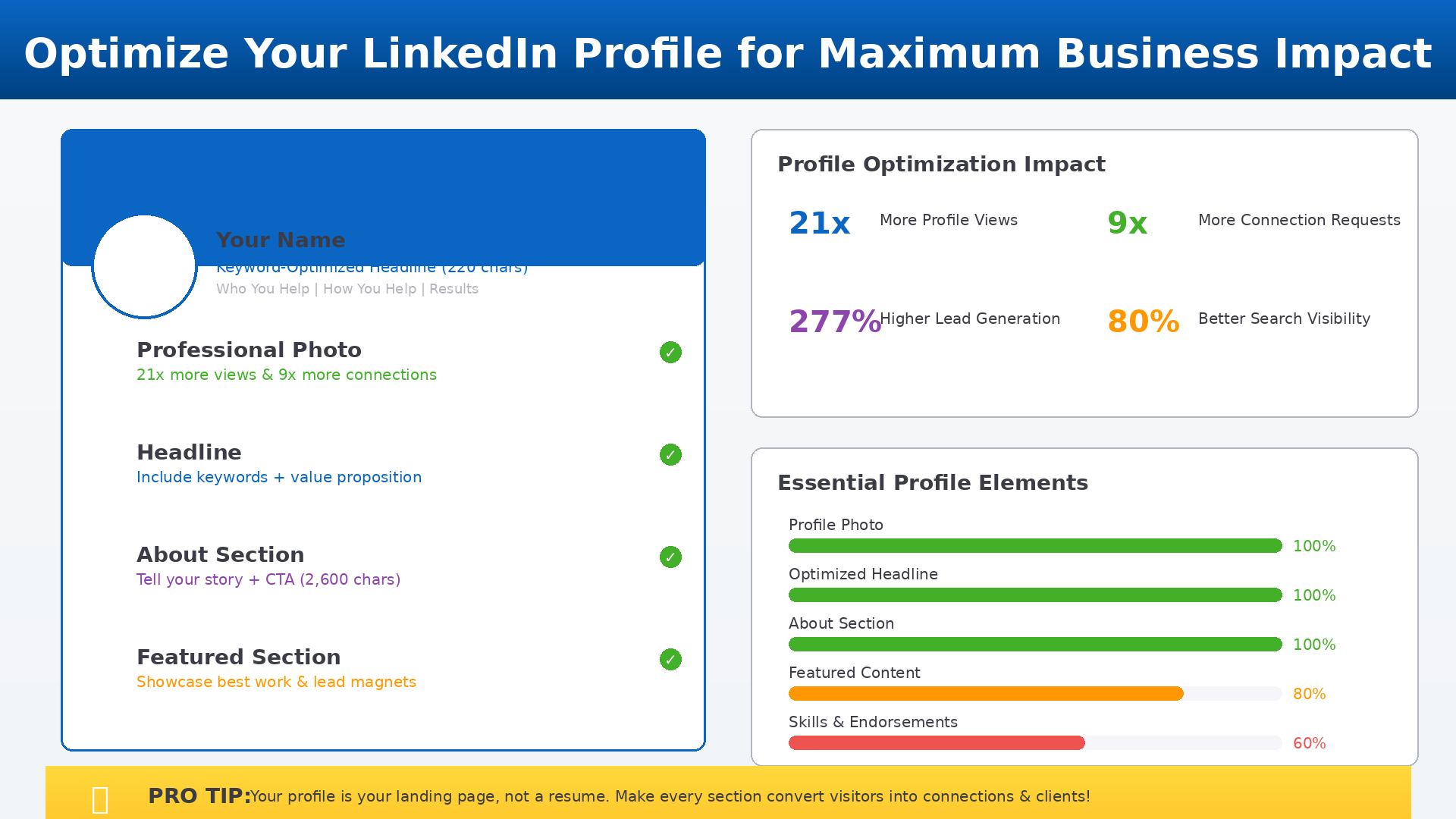
Your LinkedIn profile isn’t a resume—it’s your most powerful marketing asset. When someone discovers your content, they immediately check your profile. Make those 5 seconds count.
Critical Profile Elements for LinkedIn Marketing
- Professional Profile Photo
Profiles with professional photos receive 21x more views and 9x more connection requests (source: LinkedIn Profile Research 2025). Use a high-resolution headshot with:
- Clean, simple background (avoid busy settings)
- Friendly, approachable expression (slight smile works best)
- Professional attire aligned with your industry
- Your face taking up 60% of the frame
- Keyword-Optimized Headline (220 Characters)
Your headline appears everywhere—search results, post comments, connection requests. Don’t waste it on a job title.
❌ Generic: “Marketing Manager at ABC Corp”
✅ Optimized: “Helping B2B SaaS Companies Scale Through LinkedIn Marketing for Business | Content Strategy | Lead Generation Expert | 500+ Clients Served”
Formula: [Who You Help] + [How You Help] + [Key Keywords] + [Social Proof/Results]
- Value-Driven About Section (2,600 Characters)
This is your sales page. Structure it like a compelling story:
- Hook (First 2 lines): Address a major pain point or make a bold statement
- Problem Statement: What challenges do your clients face?
- Your Solution: How you solve those problems uniquely
- Results & Proof: Specific outcomes, testimonials, or case study highlights
- Clear CTA: Tell readers exactly what to do next (book a call, download a guide, follow for tips)
💡 SEO Tip: Naturally incorporate “LinkedIn marketing for business” and related keywords (B2B marketing, lead generation, professional networking) 3-5 times throughout your About section.
- Strategic Featured Section
Showcase your best work:
- High-performing blog posts or articles
- Lead magnets (free guides, checklists, templates)
- Case studies demonstrating results
- Video testimonials or presentations
- Media appearances or podcast interviews
Step 3: Master LinkedIn Content Strategy for Business Growth
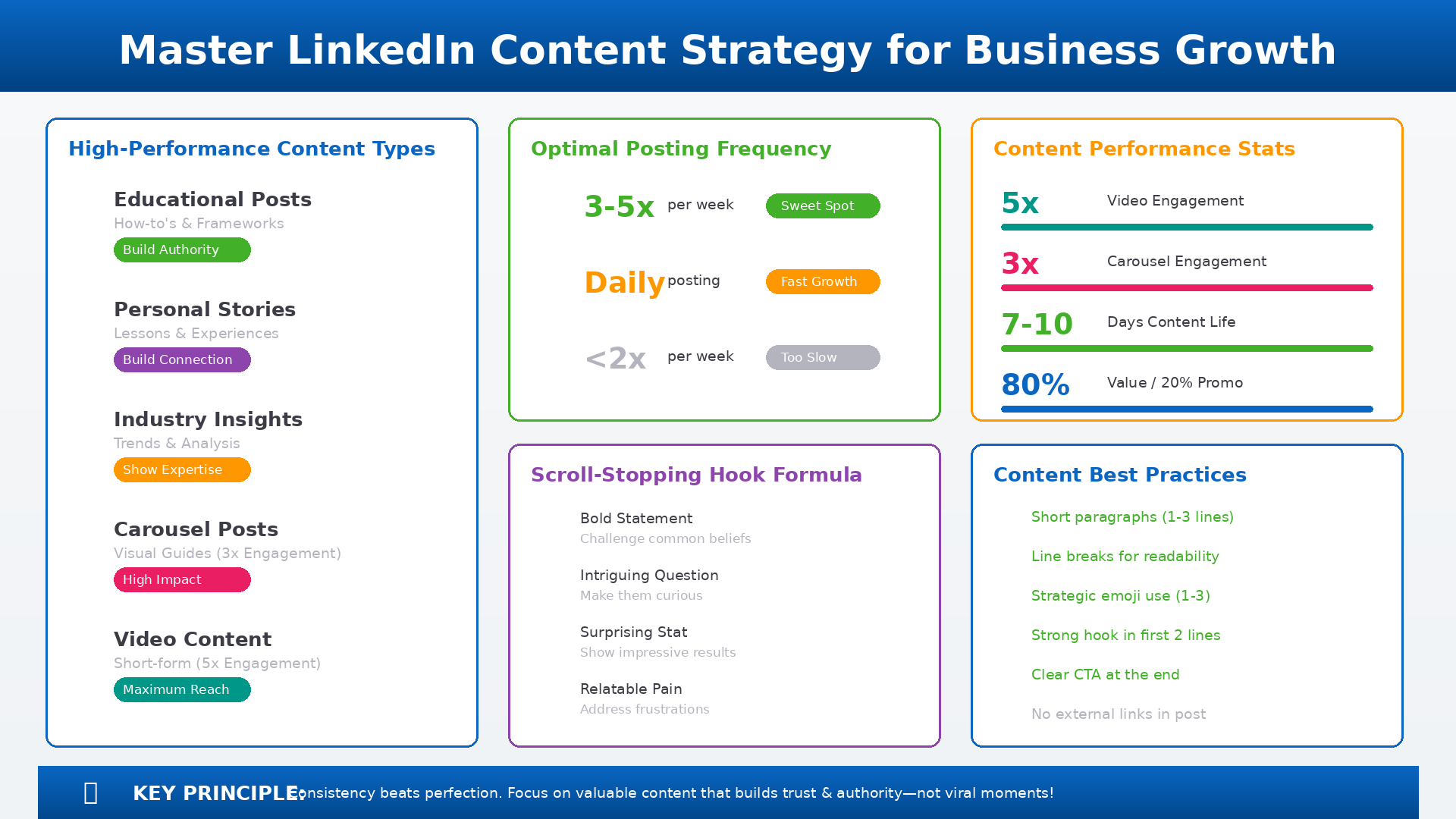
Content is the engine that drives LinkedIn marketing for business success. But you don’t need viral posts—you need consistent, valuable content that builds trust and authority.
High-Performance LinkedIn Content Types
- Educational Posts (How-To’s & Frameworks)
Example topics:
- “5 LinkedIn Profile Mistakes Costing You Clients”
- “The 3-Step Framework for LinkedIn Lead Generation”
- “How to Write LinkedIn Posts That Actually Convert”
- Personal Stories & Lessons Learned
People connect with authenticity. Share:
- Career transitions and pivotal moments
- Failures that taught valuable lessons
- Behind-the-scenes insights from your business
- Client success stories (with permission)
- Industry Insights & Trend Analysis
Position yourself as a thought leader:
- Commentary on recent industry news
- Predictions and emerging trends
- Deep dives into complex topics
- Myth-busting common misconceptions
For cutting-edge strategies, check out: Social Media Marketing Trends 2026.
- Carousel Posts (PDF Slides)
Carousels generate 3x more engagement than standard posts (source: LinkedIn Engagement Study). Use them for:
- Step-by-step tutorials
- Listicles (“10 Ways to…”)
- Before/after transformations
- Data visualizations and statistics
- Short-Form Video Content
Video posts receive 5x more engagement. Keep videos 30-90 seconds for maximum completion rates:
- Quick tips or hacks
- Behind-the-scenes glimpses
- Mini case studies
- Q&A sessions
Optimal Posting Frequency
Consistency beats perfection. Research shows:
- 3-5 posts per week is the sweet spot for most professionals
- Daily posting can yield faster growth but requires significant time investment
- Less than 2 posts per week makes it difficult to build momentum
The Scroll-Stopping Post Formula
First 2-3 lines are critical—they appear in the feed preview. Use these hook strategies:
- Bold statement: “Most LinkedIn advice is dead wrong. Here’s what actually works…”
- Intriguing question: “Why do 90% of LinkedIn posts get zero engagement?”
- Surprising stat: “I generated $500K in revenue from 47 LinkedIn posts. Here’s the exact strategy…”
- Relatable pain point: “Spent 3 hours on a post, got 12 views. Then I changed this one thing…”
Structure best practices:
- Short paragraphs (1-3 lines max)
- Use line breaks for visual breathing room
- Strategic emoji use (1-3 per post, not excessive)
- End with a clear CTA (question, request for feedback, or next step)
Step 4: LinkedIn Lead Generation Without Being Salesy
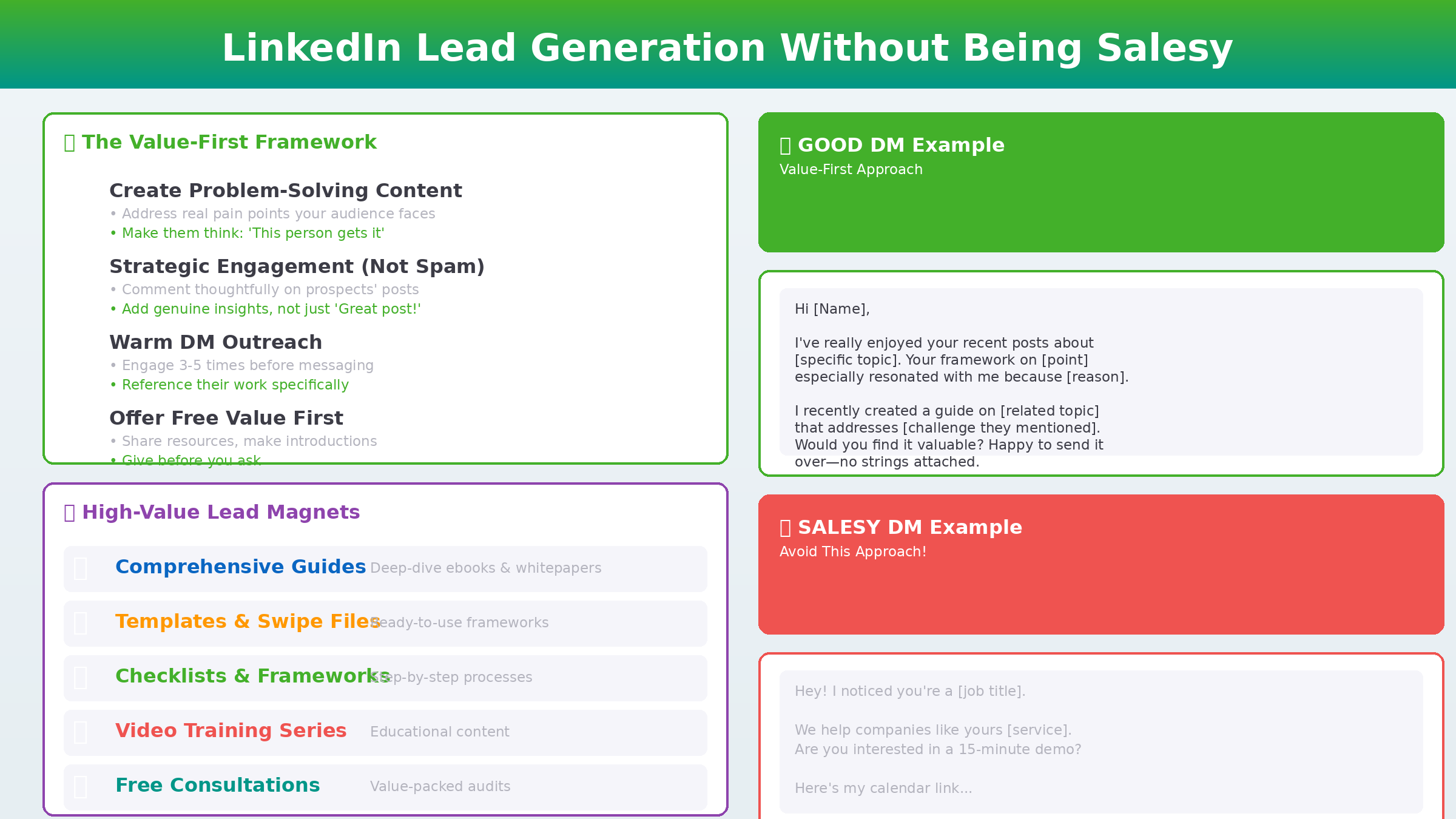
The biggest mistake? Treating LinkedIn like a billboard. Effective LinkedIn marketing for business prioritizes relationships over transactions.
The Value-First Lead Generation Framework
- Create Content That Solves Real Problems
Every post should make your audience think, “This person gets it.” Address specific pain points your ideal clients face. When your content consistently delivers value, people naturally want to work with you.
- Strategic Engagement (Not Random Commenting)
Spend 15-20 minutes daily engaging thoughtfully:
- Comment on posts from your target audience (prospects, influencers, peers)
- Add genuine insights, not just “Great post!”
- Tag relevant people who might find the discussion valuable
- Respond to all comments on your own posts within the first hour
- Warm DM Outreach (Relationship-Based)
Cold pitches fail. Instead:
- Engage with someone’s content 3-5 times before messaging
- Reference their work specifically in your opening message
- Start conversations, not sales pitches
- Offer value first (share a relevant resource, make an introduction)
Example DM:
“Hi [Name], I’ve really enjoyed your recent posts about [specific topic]. Your framework on [specific point] especially resonated with me because [genuine reason]. I recently created a guide on [related topic] that addresses [specific challenge they mentioned]. Would you find it valuable? Happy to send it over—no strings attached.”
- Lead Magnets & Content Upgrades
Offer high-value free resources:
- Comprehensive guides or ebooks
- Templates and swipe files
- Checklists or frameworks
- Video training series
- Free consultations or audits
Advanced LinkedIn Lead Generation Tools
For serious lead generation, consider:
- LinkedIn Lead Gen Forms: Pre-populated forms that capture leads with one click (source: LinkedIn Marketing Solutions)
- Sponsored Content: Amplify your best-performing organic posts to reach decision-makers at scale
- InMail Campaigns: Send personalized messages to prospects outside your network (50% average open rate)
- Sales Navigator: Advanced search and lead management for B2B sales teams
Step 5: Grow Your LinkedIn Network Strategically
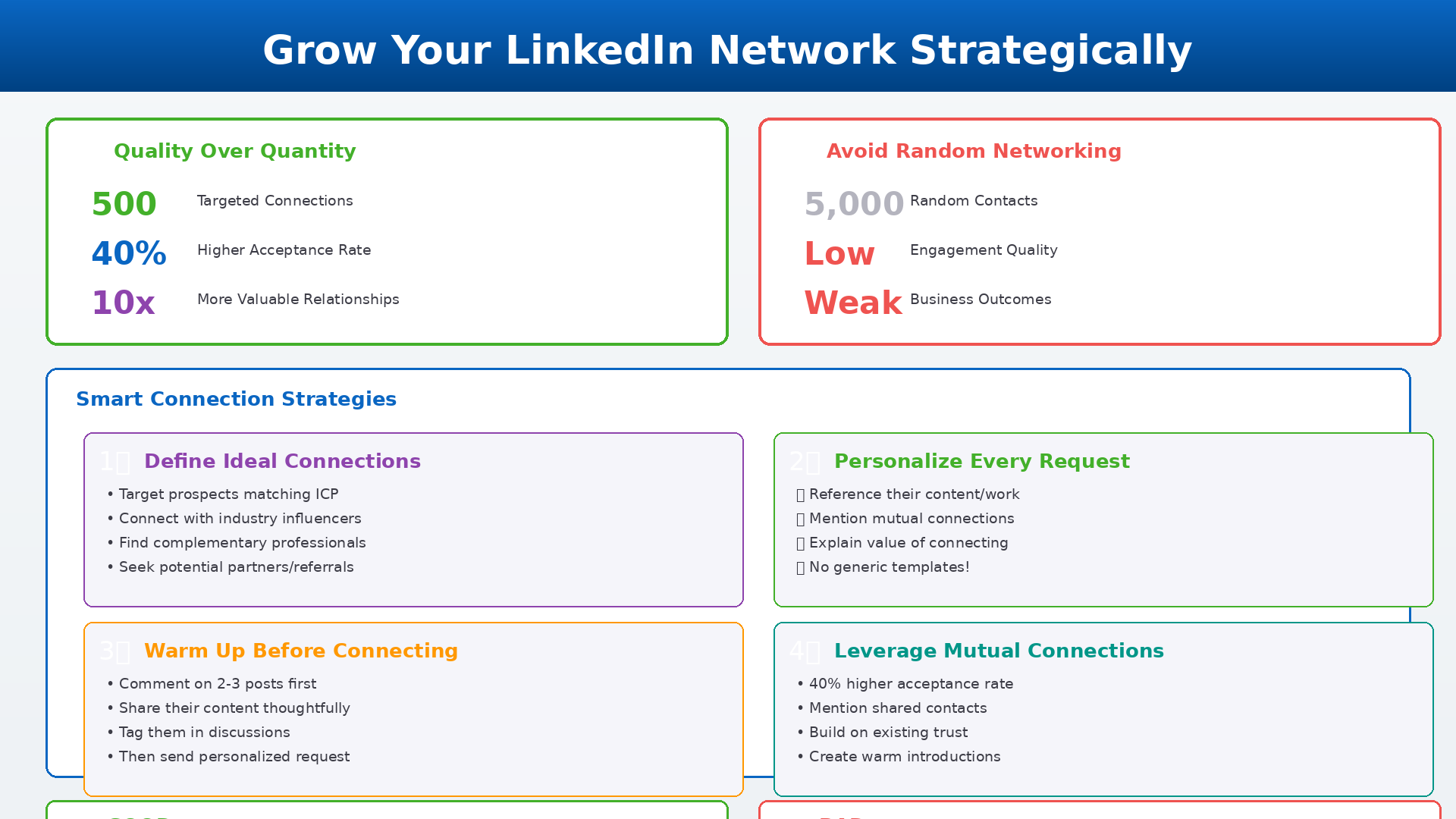
Quality trumps quantity. A targeted network of 500 relevant connections is infinitely more valuable than 5,000 random contacts.
Smart Connection Strategies
- Define Your Ideal Connection Profile
Connect with:
- Potential clients who match your ideal customer profile
- Industry influencers and thought leaders
- Peers in complementary (non-competing) fields
- Content creators with engaged audiences
- Potential strategic partners or referral sources
- Personalize Every Connection Request
Generic requests get ignored. Stand out:
❌ Bad: “I’d like to add you to my professional network.”
✅ Good: “Hi [Name], your article on LinkedIn algorithm changes was incredibly insightful. I’m implementing your content batching strategy. Would love to connect and learn more from your expertise in B2B marketing.”
- Engage Before Connecting
Warm up prospects:
- Comment thoughtfully on 2-3 of their posts
- Share their content with added commentary
- Tag them in relevant discussions
- Then send a connection request referencing your interactions
- Leverage Mutual Connections
Shared connections increase acceptance rates by 40%. Mention mutual contacts in your request:
“Hi [Name], I noticed we’re both connected with [Mutual Connection]. I’ve been following your work on [topic] and would value connecting.”
Step 6: Master LinkedIn Analytics & Optimization
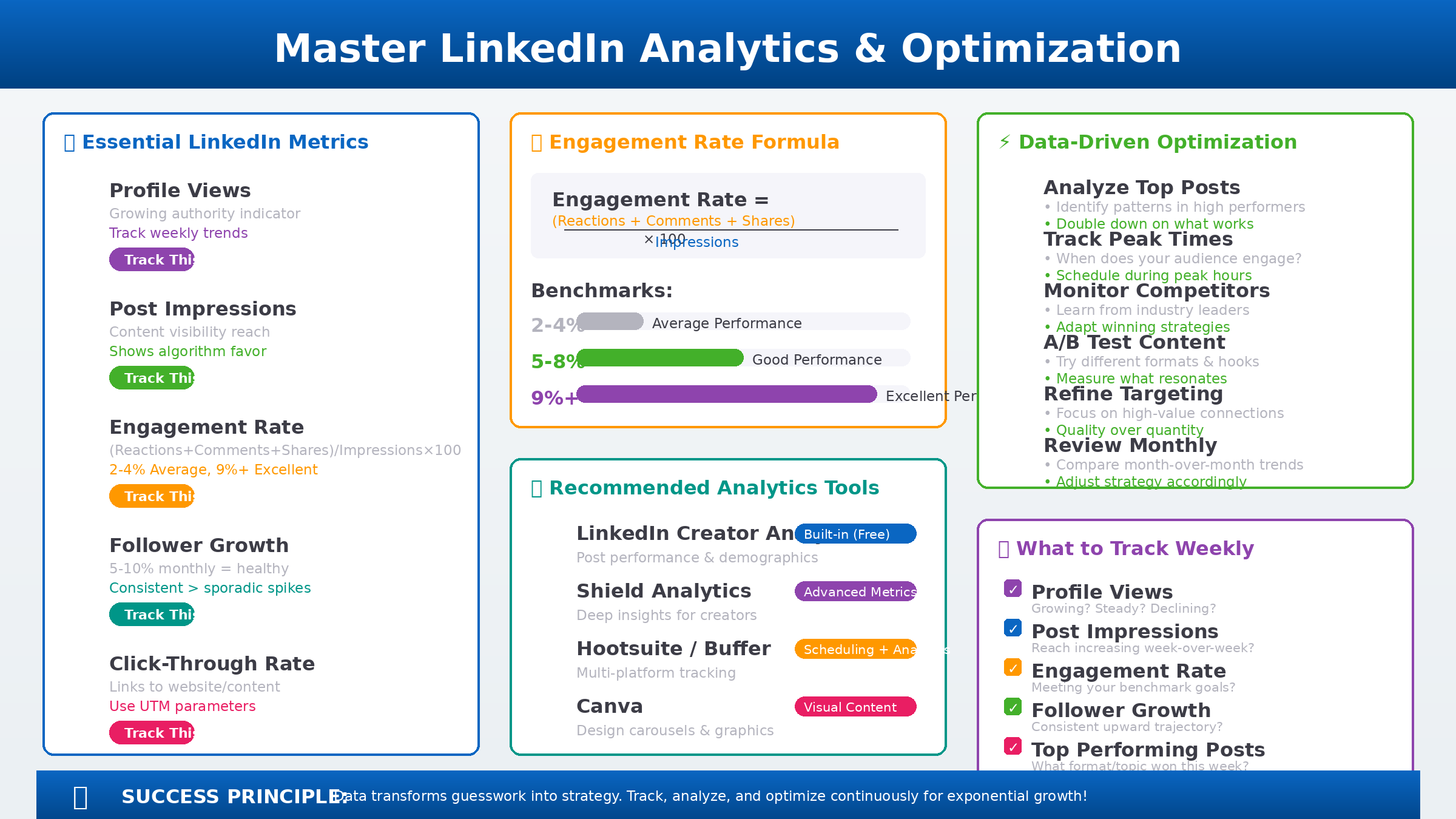
Data transforms guesswork into strategy. Track these key metrics to continuously improve your LinkedIn marketing for business results.
Essential LinkedIn Metrics
- Profile Views & Search Appearances
Increasing profile views = growing authority. Track weekly trends and identify which content drives the most profile visits.
- Post Impressions & Reach
Impressions = how many times your content was shown. Reach = unique users who saw it. Growing both indicates algorithm favorability.
- Engagement Rate (The Most Important Metric)
Formula: (Reactions + Comments + Shares) ÷ Impressions × 100
Benchmarks:
- 2-4% = Average
- 5-8% = Good
- 9%+ = Excellent
- Follower Growth Rate
Steady, organic growth (5-10% monthly) is more valuable than sporadic spikes from viral content.
- Click-Through Rate (CTR) to Your Website
If driving traffic is a goal, track how many people click your links. Use UTM parameters to measure conversions in Google Analytics.
Recommended Analytics Tools
- LinkedIn Creator Analytics: Built-in dashboard (free for all users) – track post performance, follower demographics, engagement patterns
- Shield Analytics: Advanced metrics for serious creators (source: Shield Analytics)
- Hootsuite or Buffer: Schedule posts and track multi-platform performance
- Canva: Create professional carousels and graphics
Step 7: LinkedIn Algorithm Best Practices
Understanding the LinkedIn algorithm isn’t about gaming the system—it’s about aligning with how the platform rewards valuable content.
Algorithm-Friendly Tactics
- Optimal Posting Times
According to Sprout Social’s 2025 analysis:
- Best days: Tuesday, Wednesday, Thursday
- Best times: 7-8 AM, 12-1 PM, 5-6 PM (your audience’s local timezone)
- Worst times: Late evenings, weekends (unless your audience is global)
Test your specific audience patterns using Creator Analytics.
- The External Link Strategy
LinkedIn’s algorithm deprioritizes posts with external links in the body text (they want to keep users on-platform). Instead:
- Post without links initially
- Add your link in the first comment immediately after posting
- Or use LinkedIn newsletters/articles to include links naturally
- Engage Within the First Hour
Early engagement signals quality to the algorithm. Reply to every comment in the first 60 minutes. This:
- Boosts your post in feeds
- Encourages more discussion
- Shows you value your audience
- Strategic Hashtag Use
Use 3-5 relevant hashtags maximum:
- 1-2 broad hashtags (#Marketing, #B2B)
- 2-3 niche hashtags (#LinkedInMarketingForBusiness, #B2BLeadGen)
- Avoid hashtag stuffing (10+ hashtags looks spammy)
- Prioritize Native Content
The algorithm favors:
- Native LinkedIn videos over YouTube links
- PDF carousels over external slideshows
- LinkedIn articles over blog post links
Common LinkedIn Marketing Mistakes to Avoid
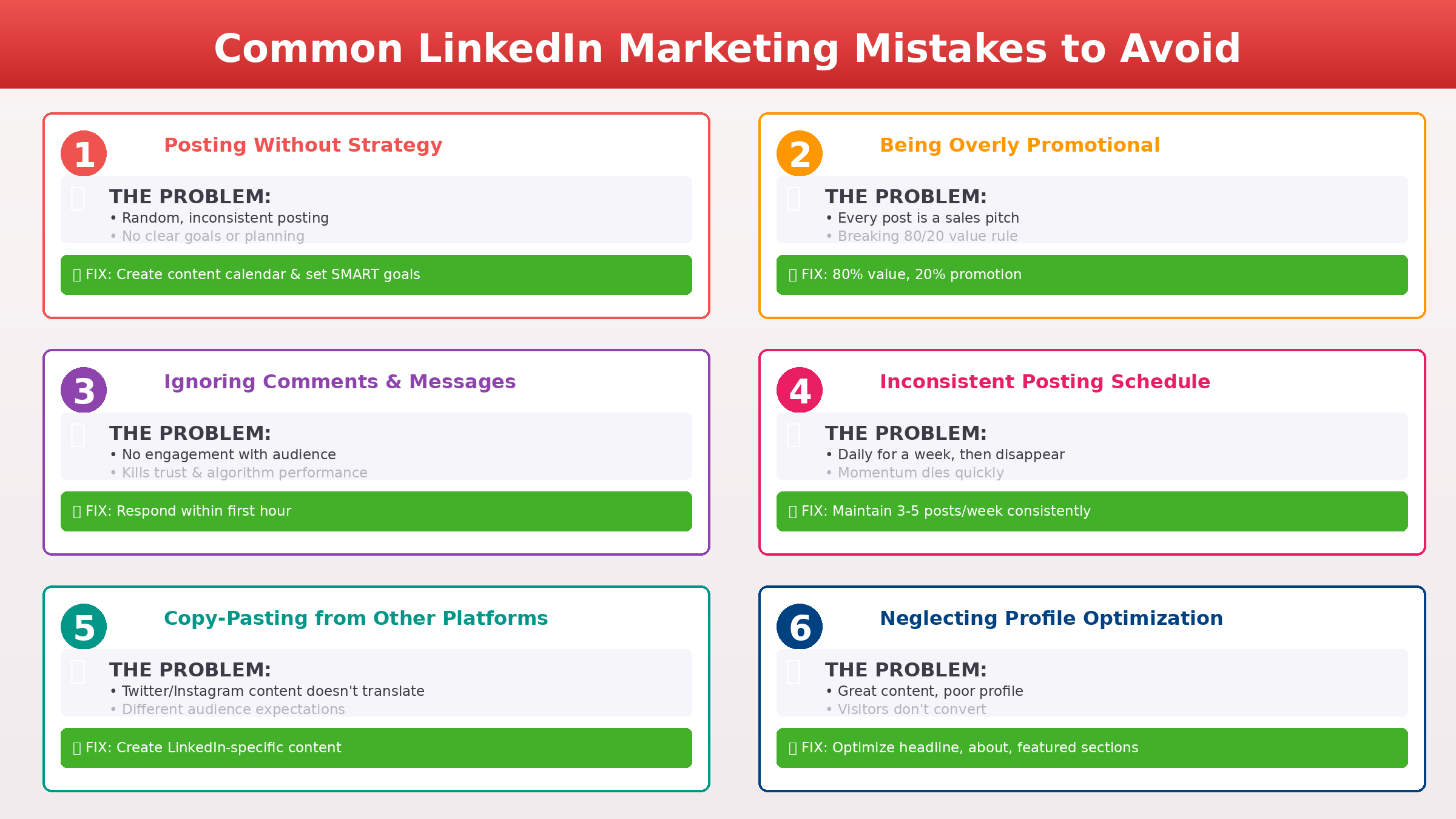
Even experienced marketers make these errors. Avoid them to accelerate your success:
- Posting Without a Clear Strategy
Random, inconsistent posting yields random, inconsistent results. Success requires intentional planning around your business goals.
- Being Overly Promotional
Follow the 80/20 rule: 80% valuable content, 20% promotional. If every post is a sales pitch, you’ll lose your audience fast.
- Ignoring Comments and Messages
LinkedIn is a social platform. Ghosting your audience damages trust and kills algorithmic performance.
- Inconsistent Posting Schedule
Posting daily for a week, then disappearing for a month kills momentum. Consistency builds trust and algorithm favorability.
- Copy-Pasting Content from Other Platforms
What works on Twitter or Instagram rarely translates to LinkedIn. Respect the platform’s professional context and unique audience expectations.
- Neglecting Profile Optimization
Your content might be brilliant, but if your profile doesn’t clearly communicate value, visitors won’t convert into connections or clients.
- Chasing Vanity Metrics
Followers and likes mean nothing without business outcomes. Focus on leads, conversations, and revenue—not just social proof.
Final Thoughts: Your LinkedIn Marketing for Business Action Plan
LinkedIn isn’t just another marketing channel—it’s a relationship-building platform that rewards authenticity, expertise, and consistency. When leveraged strategically, LinkedIn marketing for business becomes your most powerful tool for B2B growth.
Whether you’re a solopreneur building personal authority, a marketing director driving enterprise leads, or a business owner expanding your network—LinkedIn offers unmatched opportunities to connect with decision-makers who matter.
Remember: Success on LinkedIn doesn’t happen overnight. It requires:
- Clear goals aligned with business outcomes
- An optimized profile that converts visitors
- Consistent, valuable content creation
- Strategic networking and engagement
- Data-driven optimization
- Patience and persistence
The businesses winning on LinkedIn aren’t chasing viral moments—they’re showing up consistently, providing real value, and building genuine relationships. That’s the foundation of sustainable growth.
📌 Take Your Marketing to the Next Level
If you found this guide valuable and want more actionable insights on content marketing, SEO, and social media growth, subscribe to my YouTube channel for weekly strategy videos that help you grow smarter, not harder.
👉 Subscribe to Mowdud Ahmed on YouTube
Frequently Asked Questions (FAQ)
Q1: How often should I post on LinkedIn for business marketing?
A: For optimal results, aim for 3-5 posts per week. This frequency keeps you visible without overwhelming your audience. Consistency is more important than volume—posting three times weekly consistently outperforms sporadic daily posting.
Q2: What’s the best time to post on LinkedIn?
A: Generally, Tuesday through Thursday mornings (7-8 AM) and lunch hours (12-1 PM) see the highest engagement. However, test different times using LinkedIn Creator Analytics to find when your specific audience is most active.
Q3: How can I generate B2B leads on LinkedIn without being pushy?
A: Focus on the value-first approach: create educational content that solves real problems, engage authentically with prospects’ posts, and offer free resources before asking for anything. Build relationships through helpful DMs rather than sales pitches. When you consistently provide value, leads come naturally.
Q4: Should I use a personal profile or company page for LinkedIn marketing?
A: Personal profiles generate significantly higher engagement (up to 8x more) than company pages. LinkedIn’s algorithm prioritizes content from individuals. Use your personal profile for thought leadership and relationship building, while maintaining a company page for brand credibility and job postings.
Q5: How long does it take to see results from LinkedIn marketing?
A: Expect 3-6 months of consistent effort before seeing substantial results. You’ll notice early wins—profile views, connection requests—within the first month. Meaningful business outcomes like qualified leads and partnerships typically materialize around the 90-120 day mark with dedicated strategy execution.
Q6: What types of LinkedIn content get the most engagement?
A: Carousel posts, personal stories with lessons learned, and educational how-to content consistently perform best. Video content receives 5x more engagement than text-only posts. The key is authenticity—content that showcases real expertise and vulnerability resonates more than overly polished corporate messaging.
Q7: Is LinkedIn Premium worth it for business marketing?
A: LinkedIn Premium (especially Sales Navigator) is valuable if you’re actively prospecting and need advanced search filters and InMail capabilities. For content marketing and organic growth, the free version is sufficient. Invest in Premium when direct outreach becomes a core part of your strategy.
Q8: How do I optimize my LinkedIn profile for SEO?
A: Include primary keywords (like “LinkedIn marketing for business”) naturally in your headline, About section, and job descriptions. Use industry-specific terms your target audience searches for. Complete all profile sections—LinkedIn’s algorithm favors comprehensive profiles in search results.
Q9: What’s the difference between LinkedIn followers and connections?
A: Connections are mutual relationships (both parties agree to connect), allowing you to message them directly. Followers see your public posts but aren’t connected to you—they can’t access your full profile or receive direct messages. For business, prioritize building relevant connections for deeper relationship opportunities.
Q10: Can I automate my LinkedIn marketing activities?
A: You can schedule posts using approved tools like Hootsuite or Buffer. However, avoid automation for connection requests, comments, and DMs—LinkedIn detects and penalizes bot-like behavior. Authentic engagement requires genuine human interaction. Automate scheduling, but never automate relationship-building.